


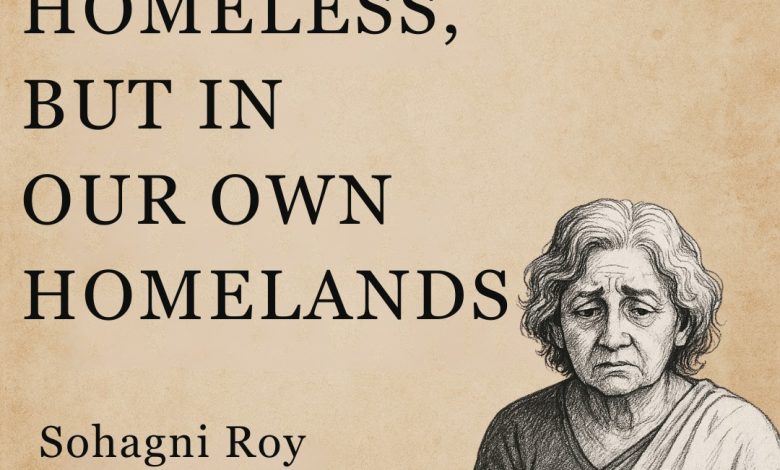
In this writing, I draw on the excerpts from a journal, which I have been writing since 2018, scripting my everyday experiences , memento-mori, recognizing loneliness, death , loss and grief vis-à-vis life in general, through personal journey.
What if death did not ride in on one huge buffalo but on thousands of tiny ants that crept silently under the door as I kept my eye on the peephole?
I remembered another one of my earliest memories. I had seen a beautiful, bright, metallic, shiny beetle in the grass upturned and floating magically across the grass while all of its limbs were still. It was so disappointing to
discover that the majestic, magical bug was dead, and it seemed to move because it was being carried by tiny red ants to their anthill. What could look like royalty being carried on a palanquin by tiny slaves was really death, carrying its dinner.
“I often picture myself living on a mountain top, in the most stormy country (not the coldest) in the world. Is there such a place? If there is, I shall go to it someday and turn my heart into pictures and poems.”
This excerpt is from one of Kahlil Gibran’s letters, dated 1st March, 1914. I have always hunted for a reason for three things in this world: how in the same world, in the same year, here was
Gibran writing this and there was the First World War about to begin; how my grandparents loved each other like they were seventeen; and how Maa finds the will to send me good-morning messages on WhatsApp at exactly nine every day with images of unknown children.
Maa does not realize that the space in my smartphone is limited, like the pyres in this city during the pandemic. She messaged me last week, “Look, Pakhi, I found your old diary while cleaning the cupboard. It had these words by Agha Shahid Ali, ‘It rains as I write this. Mad heart, be brave.’ Oh, and I learned to make your favourite Chinese food yesterday. Come home and see, I make it better than those restaurants that burn craters in your pockets.” Strangely, as I read this, I terribly missed her Kanda Poha. Maa learned it from my Nani and guards the recipe with all her life.
Nani still lives in the hills, makes her own food and experiments with her spices now and then. After my grandfather passed away, we urged her to stay back in Kolkata. But she would not listen. That’s the thing about Nani; she always knew what she wanted. Her old age, husband’s death, more medical bills, nothing could change her mind. She went back to her home in Darjeeling. The day before she left, I asked her, ‘Why won’t you stay, Nani?’
She smiled at me, “As long as that home lives, that bed gets made every night, the kettle is washed every morning, your grandfather lives. I cannot abandon him after all these years. I married him when I was eighteen. He was transferred to Darjeeling two years after our marriage. I was pregnant with your Baba at that time. I made my home there, from scratch.”
‘But weren’t you lonely there? Nana must’ve been at work in the library during the day.’
“Yes, he was. And I was lonely. For almost a year. When your Baba was two years old, I started making sweaters. I’d knit these sweaters every afternoon, taking sips of chai and bites of onion fritters in between. At the end of the month, I gave them away to a local store that sold them to tourists.”
‘And how did you spend that money?’
“I would buy movie tickets for myself and your Nana. I’d surprise him. He would be back from the library, take off his coat, wash his face and sit on the armchair. The old brown one, in our living room in Darjeeling, you remember? He’d sit there and the first thing he asked was, ‘How was your day, Monimala?’ Just then, I’d walk up to him and say, “Was thinking of going to the movies.” He would ask, ‘Oh, but the ticket?’ Back in those days, there was only one movie hall nearby and the ticket queue was quite long in the evening. You had to stand for half an hour. The easier way was to collect your ticket in the morning. I would smile like a child, flash the two tiny tickets and his face would cheer up. All the day’s tiredness would just be wiped off from his face at once. When he fell very sick during his last days, I asked him, “Why would you be surprised every time I’d tell you about the tickets? You must’ve been able to guess after a few times. And your face would glow up, so I knew you weren’t pretending to be surprised.” He touched my palms and gently said to me, ‘Moni, I wasn’t pretending. But my face would glow up not for the tickets. I knew you got them beforehand. But when you flashed them before my eyes, your eyes would light up and looking at you then, my heart would be the happiest. That’s the secret of the glow.’ I could only break into a smile.”
Movie tickets and my grandparents went a long way. My grandparents met in a Bombay movie hall with soft yellow lights, a wide screen and the magic of Gulzar. The curfews were early and the pocket money came late. However, amidst staring at the screen, there were glimpses, grinning, stolen kisses and Kanda Poha in a steel tiffin box. After fifty years now, ten years since Nana’s death, all those movie tickets, some torn and some faded, sleep safely inside Nani’s almirah. She opens her almirah once in a while, runs her wrinkled palms over the frail paper, breaking into a strange smile. Nani told me once that she does this to remember the touch of those old tickets.
‘But why do you have to remember them? You can just open your almirah and take out the tickets when you want to.’
“Well, old people go through strange things sometimes, my child. The thing is, our sense of touch diminishes with age and we all lose touch receptors slowly over the course of life. I will,
you will, your Maa and Baba, everyone will. When they’re old, very old. Don’t worry, it’s a long time from now,” she laughed.
‘Is it really true, Nani? I never thought I could lose my sense of touch.’
“Sometimes, you think that there is this one thing that you can never lose. You know it so well that you don’t ever question it or think about it. You’re used to its presence. And then, one day, it’s just gone.”
Nani had known Nana for 50 years now, forty-five of them, as his wife, yet this simple fact never sounded enough of an answer to even her, let alone his mind buzzing with the jolting suspicions accompanying typical Alzheimer’s.
However, most days waking up from his afternoon siesta, Nana would exclaim, “Who are you?” , having taken a look at her. “What are you doing in my room?”
“Well at least you are awake”, Nani scoffed, picking herself up from the bed and heading outside. She stood just outside of his bedroom, witnessing as he ferociously circled the space, shooting angry side-glances at her from time to time. She knew that his physical exercise was to be accompanied with a barrage of perplexing questions. Well today, Nana wanted to know who she was.
In these moments, she has always believed that his pain was greater than hers, the pain of being a lone ranger in the barren island. But no matter how hard she tried, the lump in her throat when he asked her who she was always threatened to choke her. She saw Nana writhing in agony, unaware of where he was, and even who he himself was.
As days would pass, he would look at himself in the mirror and not recognise who it was. But she knew that in those moments, she would be standing beside him, reminding Nana, his name
over and over again. But here she was, apparently unable to even repeat her own name, for words, as she discovered , they start sounding meaningless if one repeats them too many times.
Nani watched him palpitating as he settled himself to catch his breath. All of his little episodes had the tendency to leave both of them out of breath. Hers was more emotional, than physical, for it was heartbreaking for her to imagine that the person she had respected for so long, couldn’t even be called a person anymore.
It was more than just the toll of him not recognising her. It was literally as if a person drifted away bit by bit, in front of her own eyes.
“Moni, bring me tea”, Nana would call out.
Yes, he always remembered her, when he missed his evening adaa-golmorich diye dudh cha . It was amazing how he could swim in and out of the memory of her existence. It would have been miraculous, if it were intentional.
‘Will I ever lose you, Nani? I don’t want to live in a world where you aren’t there. I don’t think I can…’
Recalling this old conversation soaked in my childhood naivety, it hit me that it has been almost a year since I have visited Nani and watched ‘Aandhi’ with her. ‘Aandhi’ was my grandparents’ comfort movie. An hour before the local channel would play ‘Aandhi’, Nana would wipe the TV screen and Nani would chop onions and potatoes for Kanda Poha in the kitchen. I could strangely recall the smell of the spray of Colin, mustard and green chillies all at once. Meanwhile, my own palms reeked of sanitizer as my fingers swiped my six-inch plastic screen to find a message from Maa. Touch was a distant memory now and I finally realized the urgency in Nani’s palms; trying to grab all that she can, trying to remember, to save, to hold on to, to live. I understood Nani’s hunger to remember, I understood Nani’s loneliness.
It was thirty-three minutes past nine and there was no good-morning message from Maa. An hour ago, I had read in the newspaper about a man from Kolkata who sang ‘Tera Mujhse Hai Pehle Ka Nata Koi’ through a video call to his dying mother in the COVID ward. I read about a girl who jumped into the burning pyre of her father because she was not allowed to touch his body after the virus took his life. I left Maa fourteen angry messages and ten phone calls.
Suddenly, my phone vibrated.
“What happened? I was watering your Gulmohar tree. Good morning, my Pakhi.” ‘Nothing, Maa. Good morning.’
“Someone is turning into her annoying mother. Half an hour late and I get flooded with all these texts?”
I broke into tears and whispered to myself, “Mad heart, be brave, mad heart, be brave.” ‘The lockdown here ends tomorrow. I’m coming home, Maa. I’m trying this week. I have to get the tickets.’
“Ah, at last! Come soon. What do you want to eat? I’ll make some Kanda Poha for you.”
This is the mother I grew up watching. I grew up watching her cook for everyone but no one ever asked her, “What do you want to eat today?” Her kitchen reminds me of a poem where a lamp-seller sells lamps throughout the day and returns to a home of pitch darkness.
After booking a ticket to Kolkata, I wrote down Nani’s Kanda Poha recipe; whatever bits I could recollect. When I returned home, I made Maa a plate of Kanda Poha and as I squeezed a lemon on it, she gently squeezed my palms. My mother, my tired mother, with the hunger of a hundred years, sat at the table. I buried my teary face in her soft cotton saree and asked, ‘Maa, was the salt okay?’
Home was a point in time for me.
In the early hours of half-night-half-dawn, when I was half asleep and half awake, my thoughts intermingled with my dreams like wisps of smoke. When the alarm rang I wasn’t sure if it was in my dream or in the real world. I just lay there, weighed down, as it were, under a blanket that was so heavy that I couldn’t move even if I wanted to; made heavier by the fact that I did not want to. I chose to return to the mixture of thoughts, imagination and dreams while it lasted. I thought of that time when this house was my home. I was a child on the rooftop, running barefoot, wearing shorts and a Spiderman vest, bouncing a worn-out rubber ball against the wall where it marked dull-red circles, waiting with my sister for Baba to come home. “Do you think Baba can carry us both on his shoulders?”, she asked. “Yes, but he will only carry whoever meets him first at the gate”. The sun was setting, the shadow of the gulmohar was lengthening and our ears were trying to catch the sound of Baba’s scooter. Over time, every vehicle in the neighbourhood had aged into its own unique sound. Our scooter had a tinkling clattering sound that came from a loose nut in the spare tire, and a distinctive crunch-hiccup from the engine when the gears changed. My sister often heard it first but I ran faster. There was the smell of Rajasthani cooking in the air from the houses around, and the smell I imagined was the first I remembered from my childhood – the metallic, warm smell of my mother ironing clothes downstairs. The sound of returning parrots pierced the air, as they flew in huge troops, tails stretched straight under golden clouds.
Maa was calling out to me – this sounded like the real world – and I tried to focus on my imaginarium, willing it to last – but this was about Baba. His heartbeat was above 250, the oxygen-saturation was fine but he was sweating, should we call the doctor? I willed my eyelids open – each weighing a ton – as my ears still strained to hear the shrill horn, the tinkling loose nut – and maybe I just about heard it as the last of my dream evaporated. I was awake. His sugar was 220. Ma was wailing by now. I noticed the drooping daisy plant on the window sill as I jumped out of bed. It needed watering. Where were my slippers? My father was fine last night. His appetite was better for a change. He had taken all his medicines – for sugar-control, prostate, blood pressure, appetite, and the vitamins. His last chemo was ten days ago. God knows what was wrong now. I sleep-talked through calling the doctors – I knew the routine – I knew what I would say and what they would say to that and what I would say to that. Yes, yes, thank you. We will monitor the blood pressure, oxygen, pulse, sugar, fever – we will get back when there’s a red flag. Ok thank you Doctor.
The inevitable surprise had struck about six months back.
What raised its head as a breathing difficulty turned out to be a chest-full of fluid and collapsed lobes in the right lung. Bronchovascular markings were prominent. Reticulonodular opacities were seen in bilateral lung fields, suggestive of early interstitial lung disease. None of it made sense then – it was like mugging-up for a biology exam the night before. The extracted fluid tested negative for tuberculosis but positive for ‘abnormal cells’. I was in a daze as terminologies engulfed me – cytology, cyto-pathology, immuno-histochemistry, biopsy, histopathology, lymphadenopathy – it could have been a sarcastic poem if it wasn’t about my father. If it wasn’t about death.
Baba became an indexed file with prescriptions, reports and bills. Maybe the reports were trying to be nice. ‘Poorly differentiated atypical cells’, ‘suspicious’ for carcinoma was designed to leave some room for hope. But there wasn’t much in our hearts. Once it appeared, it coiled around us, squeezed our breaths out and began the death-roll. ‘Favour adenocarcinoma, stage-4, metastasis in the bones and pancreas’ – was a convoluted way of yelling ‘Checkmate’.
I remember running, and being numb. From phone call to appointment, to the billing counter to the waiting room, to the weighing machine to the blood-pressure station, to the doctor’s chamber, to the sample-collection-room to the path-lab, to radiology and the reports section to the internet to more calls and appointments. A pigeon that knows that all the windows are closed, and what looks like air is really glass, will still flap from room to room. I did not feel like a clueless pigeon though. I felt what Abhimanyu might have on the thirteenth day of the war, stepping into the Chakravyuha knowing how it ends. Every time I crossed a smiling lady in the hospital who asked if she could help, I felt a row of soldiers close behind me. But I had to keep moving. It was the rule, and the destiny. I was prepared, in hindsight, from the moment I saw the white lung on the lightbox. I recognised the ants – but I wasn’t afraid as long as I was running, and not still.
I was prepared for the confusion, the weight of decisions. Should we get a chest tube inserted for drainage? It’ll make him feel like a patient. Do we ignore cholesterol for now? What can frothy stools indicate? When do we switch to palliative care? Will immunotherapy work even if the PDL-1 was 0%? Were we treating the reports or the patient? I kept asking Baba what he wanted, but he said nothing. I couldn’t read his thoughts. Ma was so nervous that I had to shut her out. My sister found it too hard to bear and just forwarded me articles on miracle cures. Everyone advised, no one helped. There were days I did nothing –
standing frozen on a traffic island with blinding headlights and deafening honks from all sides – just trying to make sense. I knew that the weight of these decisions would be on my shoulder long after the, well, ‘situation’ passed. This constant worrying had become a constant, throbbing headache. What I was less prepared for was the stalemate. I knew death more as the bullet that hits you when you are running from another – as the drug overdose, as the clot that blocks blood to the brain, as the heart that fails – like it almost did four years ago for Baba – or as the truck that rams the motorcyclist in the night, on the wrong-side at full speed with its headlights off. I was less prepared for the slow, by-a-thousand-cuts version, the kidney that stops working, the cancer that keeps returning, the dementia that just worsens.
The cancer crept in insidious ways till it filled our lives. The house smelt of it – of medicines and disease, and that dank urine-in-the-carpet smell that malaise has – of rot and ailing dogs. My phone was full of reports, scans and prescriptions. I was cleaning bedpans. The kid got shouted at more often. The house-help left. The tap dripped. The garden was dry. The broken bolt never got fixed. Everyone was tired and on a short fuse. We lived under a black cloud that never parted and kept getting heavier. The parrots stopped coming by, or we didn’t hear them anymore.
I pacify my younger self, the child within me, “Of course you can have his magnifying lens – he won’t mind, I’ll tell him – and his coin collection. You can read his old books, but be careful. Baba will be fine. He is ill so he is sleeping. Once he is better, he will tell you stories again. And then they lived happily ever after. Then people become stars. Then he goes to heaven and is forever happy”. He does not grow thinner in the meantime till his thighs are the width of my wrists and his skin hangs in empty dry folds. He does not get weaker and sicker and smellier till he can’t push his stools out or keep his piss in; and he is no longer himself – till one day he does not recognise you or me. He hallucinates. The doctors call it an altered sensorium. The sense of time goes first, then of place and then of person. Maybe this is nature’s way of making it easier to deal with – when the person who passes away does not resemble the person one remembers.
Every now and then I have to take a break and step out onto the balcony because I don’t want to cry . I’m lying. Baba will not be fine. It’s dust to dust, and the dust always wins in the end.
I envy those who lost their parents suddenly, in their sleep – turned to hard, cold wood in the morning. They tell me I’m lucky I have time. But they haven’t compared that to this. There are no nostalgic
heart-to-hearts. Baba mostly stares into space. He resists medicines. They are at the door but they haven’t knocked. The armies of ants wait on wiry feet, antlers waving, for what will be theirs in the end. I am tired. When I wake up, the house is still and silent. But I am not sure if I’m fully awake yet. Maybe it is over. I don’t know. The headache is gone. Maybe I just dreamt Baba was ill and the alarm will ring any moment now.
The bed has a crumpled hollow where he slept. Maybe he has managed to go to the toilet by himself. There’s still that deafening silence that follows a bomb blast – but for a tinny ringing in my ear. I can’t remember the thoughts that kept me awake last night. There’s the taste of either salt or blood in my mouth. It lasts for a long time, or perhaps just some moments. Eventually the noise of the world floats in again. I can now hear dogs barking in the distance. Everything will be fine. When the wave recedes, we will start building our sand-castle again.
There’s a daisy nodding beside the window.
We are talking about two kinds of memory over here, which is interesting, and that is traumatic memory and interactive memory. Traumatic memory is a memory which is very close to the moment of trauma when the brain and the mind still processes trauma and is unable to process it completely.
So, only when the entire process is complete, which takes some period of time, sometimes many years, sometimes a long period of time only after that will traumatic memory can be normally converted into interactive memory, in the sense that it can become a story, it can become something of an account, some representative account of the trauma.
But for that to happen, there has to be a passage of time, which is indefinite in quality, you cannot define, you cannot quantify or predict that quantity of time. Traumatic memory become interactive memory always goes through a process of transition.
Narrativization when coupled with historical memory, when coupled with historical materiality can become a very unique form of representation which is to say that it could represent presence as well as absence. It can represent articulation as well as silence. The silence of the category is important over here. It almost becomes a representational category. It becomes an experiential category. It becomes an ontological category.
When my father passed away, grief arrived with quiet intensity, yet society demanded it be loud and visible. My mother and I had already endured months of watching him suffer from esophageal cancer, seeing him fade day by day, and feeling our hearts break in silence. We grieved then, privately, in those final two months as his life slipped away. But after his death, people expected a different kind of grief from us—a public display, a recognizable performance of sorrow. The quiet pain we carried, the exhaustion, the helplessness—none of it seemed enough.
The intimate, raw grief felt in private stands in stark contrast to the scripted sorrow society expects to witness. Is there a “correct” way to grieve, a way that looks suitably broken to others?
Grief began for us long before my father passed away. It came quietly and without warning in the hospital room where he learned about his illness. This started a long, tough journey that changed how my mother and I felt about loss.
Grief began for us long before my father passed away. It came quietly and without warning in the hospital room where he learned about his illness. This started a long, tough journey that changed how my mother and I felt about loss.
Our real grief had already been expressed in the rawest form during the last months of my father’s life. We lived through his pain with him; we watched him struggle and suffer, helpless to alleviate it. That was when our hearts broke. The sorrow we felt then didn’t need costumes or rituals to make it real—it was there in every moment, every sigh, every tear. After he passed, our grief shifted, evolving from a shared endurance of his suffering to a quieter, internalized loss. But
society wasn’t ready to let us carry our grief inwardly. It was as if we had left something undone, simply because we weren’t performing it to others’ expectations.
For my mother, this societal script became a kind of prison. How could anyone expect her to adhere to superficial displays after experiencing such profound anguish? Did limiting colors or jewelry change anything about the love she’d lost, the life they’d shared? These expectations felt hollow, inadequate for the depth of what we were feeling. Yet, to avoid judgment, my mother had to perform some of these rituals, even as they clashed with the reality of her inner sorrow. In the end, these conventions seem to miss the point: they attempt to box grief into something that can be seen, measured, and approved. But true grief—the kind that leaves an indelible mark on one’s life—rarely fits into neat, visible boxes. It’s felt, endured, and carried, and no external performance can truly capture its weight.
In advocating for a non-performative approach to grief, it’s essential to recognize that authentic mourning is both intensely personal and unpredictable. It may involve tears, or it may involve silence. It might look like visiting a temple every day or like sitting alone in one’s room, immersed in memories. It might last a few days, or a lifetime. Grief ebbs and flows in ways that defy a timeline or a checklist of behaviors. And while our society may find comfort in visible, ritualized displays of sorrow, it must come to understand that true grief does not need an audience.
If we, as a society, could learn to respect the personal boundaries of mourning, we would liberate the grieving process itself. We would allow people to remember their loved ones in ways that are meaningful to them, free from the need to meet an audience’s expectations. This liberation from performative grief would enable mourners to reconcile with loss on their own terms, to honor the memories of those they have lost privately and meaningfully, rather than through actions dictated
by tradition or social convention. Grief, in this sense, would become less about public performance and more about personal healing—a journey unique to each individual and not a role scripted by society.
GLOSSARY
Adaa-golmorich diye cha – minced ginger and pepper strained in with tea. Nana – maternal grandfather
Nani – maternal grandmother
Kanda poha – savoury breakfast made of flattened rice
chinamatir plate – type of crockery
Written by Sohagni Roy, one of the Top 11 shortlisted authors of the TCU x Penguin Writing Competition.