

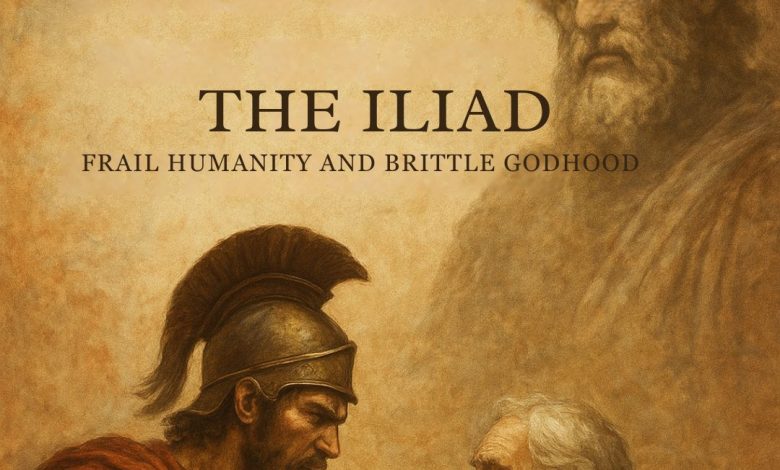
What is the tragedy at the core of the Iliad?
It is the tragedy of all Greek myth – echoed in Bellerophon, Icarus and Phaeton – hubris, overreach, and fall. The Rage of Achilles leads to inconceivable bloodshed, the death of Patroclus and Hector; and – in the mythic spaces that exist beyond the conclusion of this epic – the death of Achilles himself.
If this were the template the Iliad adhered to it would be a mere portion of a lyric and a remarkable myth from oral tradition but – just one among many. The Iliad does more. It weaves a tapestry of cause and effect, a collapsing domino of consequence that spreads outwards and consumes its major players, forcing their hand and revealing character. We see the cunning of Odysseus, the compassion of Patroclus, the duty and honour of Hector, Paris’s self-obsession and Priam’s fatherhood tested – constantly – by Achilles’ decision. This flood of causality washes away all certainties in the lives of the Trojans and the Greeks – elevating myth into the realm of the epic, operating in a realm of profound morality.
The central moral tension of the Iliad oscillates between Man and God. The scale swings, restless, until the final, heartbreaking moment when Achilles’s humanity tilts the balance. His scene with Priam is a sad, elegiac kiss of the dust – where eternity crumbles like sand under the soft but insistent realisation of mortality.
The apprehension that exists between Humanity and Godhood within the Iliad – stated without preamble or context – can be misleading. Godhood is not a reference to the compassionate Christian God of the New Testament or the Cosmic trinity of Hinduism but to the capricious gods of Greek Myth. Bernard Knox – in his stunning introduction to my edition of the Iliad (Penguin Deluxe Classics – Trans. Robert Fagles) – states plainly that to be a God is to never confront consequence. The Greek Gods are appetite made divine – they may lust after, kill or curse without rationale. Zeus, the patriarch, is a being of unimaginable power and his dalliances with humans – be it Leda, Callisto, or Europa – result in mortal tragedy. The Gods themselves pay no penalties.
Hence, it is impossible for a man to become a God. The mere attempt at transcendence, however, can cause unimaginable destruction. Our humanity cannot be shed like a snake skin. Achilles’ Rage is a manifestation of this attempt – The Iliad is the tale of its consequences.
Achilles’ anger is, initially, that of a petulant child; fuelled by his determination to punish the Achaean leader, Agamemnon, for his appropriation of Briseis – Achilles’ slave. We witness a deep sadness in him as he pleads with his mother Thetis for vengeance. He has, we learn, two possible fates; to die an old man, at home, anonymous and unsung by history; to die on the battlefield of Troy – a glorious death with immortal fame. He has the freedom to shape his legacy before he dies. As are we all. What does Achilles do with his legacy?
In an epic obsessed with fate and fixed destiny, Achilles is the rare hero who can choose his fate, and yet, his only thought is for glory on the battlefield and his legacy as a hero. He seeks the immortality that comes with fame – and weaponises his anger, praying to Zeus to sacrifice countless Achaean lives in service of this goal. His wish is to step in at a crucial moment of defeat – humiliating Agamemnon and saving the surviving Achaeans. In this instinct Achilles is godlike. In the modern world we would very rightly call this a “God Complex.” He views himself at the centre of the universe – all history and meaning weaving itself around him.
The Achaeans and Trojans who die are the named dead of Homer’s Epic. The bulk of this poem is concerned with naming the foot soldiers, captains and other warriors who die on the blood drenched shores of Troy. These names form the tender human core – Homer names not only them but their genealogy. They die in excruciating ways – their bowels pierced, their bladder ruptured, jets of blood erupting into the air as they are beheaded – the detail is repulsive and anything but glorious. Homer does not glorify war, he makes us witness the loss of every life, and witness pointless death. When we are done with the Iliad we forget factions – and are faced with an overwhelming wall of death and tragedy – an indivisible mass of mortality.
Which is the point. The glory that Achilles seeks, a heroic death on the battlefield – is a mirage. We see soldiers dying, crying, and begging for a means to ransom their life. These are not the stoic deaths of warriors but the desperate survival instincts of human beings pushed into a war they never asked for. These are sons, husbands and fathers who will leave their halls and estates empty, a void in the lives of those dearest to them that can never be filled. The story that men die “bravely” on the field of battle is of little comfort to a family bereft. It is also a lie.
Priam reminds Achilles of his shared humanity with the countless he has condemned to death by his inaction – like them he has a father, Peleus who will never see his son again; like them the halls of his home will never again echo with the tread of his feet. It is a moment of recognition that cuts through his narcissism. Homer rejects in Achilles traditional notions of “heroism” implying that the burden of being a “Hero” might be too much for an individual to bear – warping his sense of importance into narcissism.
The opening lines of this epic are a pointer to the above themes. They refer to rage and the outcome of Achilles’ inaction- the death of his own men. Homer deconstructs the hero – as a man who dooms others through inaction (echoed in Hamlet’s serpentine indecisiveness several centuries later) but also as a leader who succumbs to the narcissism of fame and hero worship in his quest for godhood.
Rage is often grief transformed. It originates from a river of pain that flows through the subterranean depths of our consciousness, affecting our lives and our destiny. Though not expressly stated it becomes clear over the course of the epic – especially from Thetis’s constant lamentations – that Achilles’ rage is a protean manifestation of his grief – for a life he is not allowed to live to completion. To grieve is to be human – to turn away from grief is Achilles’ misguided quest for Godhood.
Homer does not shy away from this grief. The Iliad is not an epic about the glories of war – it is about war’s psychological and emotional cost. Interspersed between descriptions of the actions on the battlefield are descriptions of peace – fields being ploughed, shepherds fighting wolves and lions and the felling of trees.
Humanity – real humanity is about pain and loss – it is about growing old. It is also about community, love, and – as the Shield of Achilles so poignantly captures – dances in the fields , food, drink and the experience of “living”. The suffering of life is tempered by its riches and beauty but only if we allow ourselves to look at and recognise them. Achilles does not gain redemption, what he gains is a moment of recognition – a crack of light that illuminates the darkness of his narcissism. Homer’s greatness is in the structure he constructs – the epic prose, the deaths and the war that serves as a foundation for that reclamation of humanity. It is the reason the Iliad remains to this day a profoundly moving and human book.