


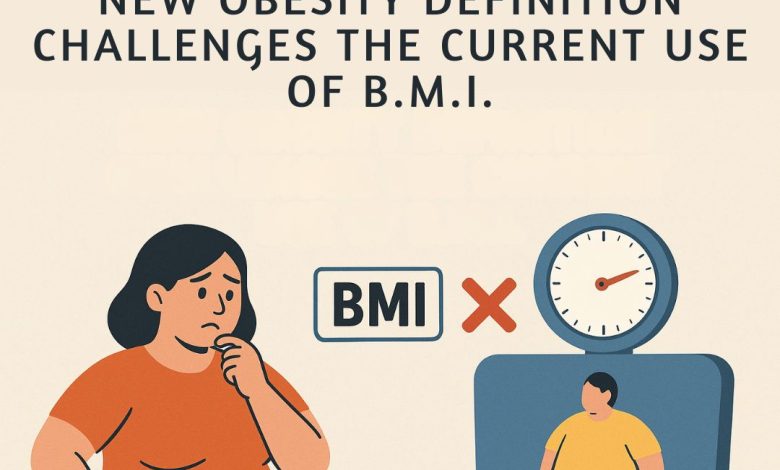
For decades, Body Mass Index (B.M.I.) has been the centerpiece for the diagnosis of obesity in clinical practice and epidemiological research. It is calculated as weight (kg) divided by height squared (m2) and is utilized for classifying populations into underweight, normal, overweight, and obese categories. Obesity is defined as a chronic, relapsing, progressive disease characterized by abnormal or excessive adiposity that impairs health- a concept far broader than weight-to-height ratio alone.
The emerging consensus in recent times has been challenging the adequacy of B.M.I. as a stand-alone diagnostic tool.
While useful for population-level surveillance, B.M.I. has important clinical limitations. It fails to distinguish between fat and lean mass, misclassifying muscular individuals as overweight or obese. It fails to capture the fat distribution- visceral adiposity, which is strongly linked with insulin resistance and cardiometabolic risk as well as abnormalities of metabolic health. There exists a category termed Metabolically Obese Normal Weight (MONW) wherein individuals with “normal” B.M.I. often present with dyslipidemia, hypertension, or impaired glucose tolerance. These shortcomings raise concern for both underdiagnosis and misclassification, particularly in populations predisposed to metabolic disease at lower weight thresholds.
South Asians, including Indians, exhibit the “thin-fat phenotype”- i.e. they have lower lean mass but disproportionately higher visceral adiposity. As a result, diabetes, cardiovascular diseases, and hypertension manifest at lower B.M.I. levels compared to Western populations. To address this, the World Health Organization (WHO) and Indian consensus statements recommend the following lower thresholds for obesity in Asian populations:
Overweight: ³ 23 kg/m2 and Obesity: ³ 25 kg/m2
Even so, these cut-offs do not adequately capture the full burden of obesity related morbidity in India, given the heterogeneity of fat distribution and metabolic impact.
In 2020, the Canadian Adult Obesity Clinical Practice Guidelines emphasized a shift from weight-based to health-impairment-based definitions of obesity. According to this framework, obesity is present when excess or dysfunctional adiposity leads to negative health outcomes. This requires a multidimensional approach including
- Anthropometry– waist circumference, waist-to-hip ratio, body fat percentage
- Metabolic Markers– fasting glucose, HbA1c, lipid profile, blood pressure
- Functional Assessment– mobility, sleep quality, reproductive and endocrine health
- Patient-reported Outcomes– energy levels, psychological well-being, quality of life.
This definition mirrors the diagnostic criteria for other chronic diseases where organ dysfunction and clinical consequences determine the diagnosis instead of a single numeric value. Transitioning to this broader definition has significant clinical implications, such as:
- Individualized Management, which shifts emphasis from weight reduction alone to improvement in metabolic health, functional status, and quality of life
- Early Detection of MONW allowing time for preventive interventions
- Reduced Stigma by recognizing obesity as a multifactorial chronic disease rather than a lifestyle failure thus fostering empathetic, evidence-based care
- Policy and Research Adaptation by developing population-specific diagnostic and therapeutic guidelines that are crucial for India’s unique risk profile.
The evolving definition of obesity demands that we move beyond the B.M.I. centric paradigm. While B.M.I. retains utility for screening at the population level, it is inadequate as the sole diagnostic criterion. A health-impairment-based approach inclusive of anthropometry, metabolic risk, functionality assessment, and patient-reported outcomes provides a more accurate, compassionate, and clinically relevant framework.
For India, where the dual burden of rising obesity and metabolic disease presents an urgent public health challenge, this paradigm shift is essential. It is time to redefine obesity in clinical practice not as a number, but as a chronic disease with measurable health consequences.
References:
World Health Organization. Obesity: preventing and managing the global epidemic. WHO Technical Report Series, No. 894. Geneva: WHO; 2000.
Després JP. Body fat distribution and risk of cardiovascular disease: an update. Circulation. 2012 Sep 4;126(10):1301-13. doi: 10.1161/CIRCULATIONAHA.111.067264. PMID: 22949540.
Ruderman NB, Schneider SH, Berchtold P. The “metabolically-obese, normal-weight” individual. Am J Clin Nutr. 1981;34(8):1617-1621.
Yajnik CS, Yudkin JS. The Y-Y paradox. Lancet. 2004;363(9403):163.
Misra A, Chowbey P, Makkar BM, et al. Consensus statement for diagnosis of obesity, abdominal obesity and metabolic syndrome for Asian Indians and recommendations for physical activity, medical and surgical management. J Assoc Physicians India. 2009; 57:163–170.
Wharton S, Lau DCW, Vallis M, et al. Obesity in adults: a clinical practice guideline. CMAJ. 2020;192(31): E875–E891.
Ikoue I, Takahashi K, Katayama S. [The impaired glucose tolerance in the pathogenesis of dyslipidemia]. Nihon Rinsho. 1996 Oct;54(10):2672-8. Japanese. PMID: 8914426.
Rothman, K.J. (2008). BMI-related errors in the measurement of obesity. International journal of obesity (2005). 32 Suppl 3. S56-9. 10.1038/ijo.2008.87.