

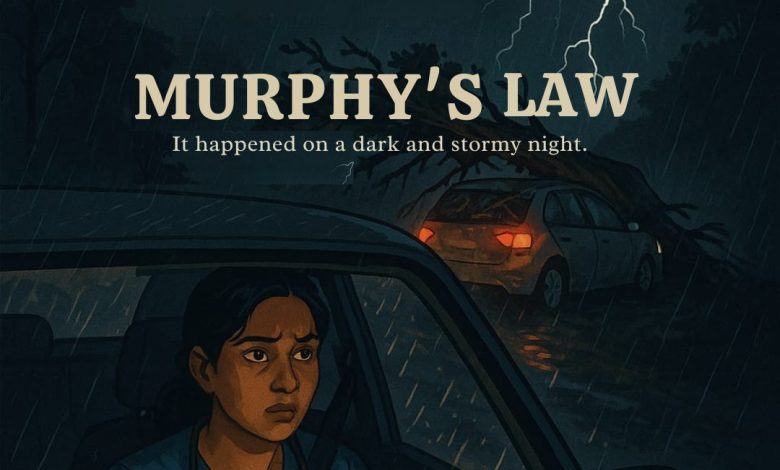
It happened on a dark and stormy night.
Dear reader, I know what you are thinking!
Stories that begin with the line “a dark and stormy night” are usually flights of fantasy and rather predictable. I assure you that my story is neither. Read on and you will believe that truth is stranger than fiction.
Although this happened to me a while back, it is only today that I have found the courage to write down my innermost thoughts of that night. You might find the official account of what happened in the local newspaper where I was hailed as some kind of local hero. If you read this until the end, you might feel differently.
If there is a predictable part of my story, it is what happened during the year before the aforementioned stormy night When I, a thirty-year-old woman fell in love with “an Unsuitable Boy” (someone who practiced a Different Religion), our disapproving families responded with a drama worthy of cinematic immortalization.
We were disowned, cast out of our families and consequently had to fend for ourselves.
Naturally we did what Romeo and Juliet should have done in real life. We eloped, got married, were pregnant a few months later and became proud parents to a baby girl.
You are thinking…YAWN!..what’s new…but wait!
My story is just beginning.
My husband had barely begun his training to be a neurophysician and I was a just-qualified surgeon. Medical education is expensive and our debts began mounting. As the qualified professional and thus the bread-winner for the next few years, I applied for jobs everywhere. The most lucrative offer of acceptance came from a hospital in another city. Separating our little family was a difficult decision for us, but making lemonade out of every little lemon that Life tosses at me is what I do best.
With my baby in tow, I moved hundreds of kilometres away from my baby-daddy to live and work among strangers in a new city.
A nursemaid for my baby (a young inexperienced girl was all we could afford), a rattletrap car for my local transport, a tiny apartment on rent as close to the hospital as my budget allowed and I was prepared. As prepared as any working mother can be when she leaves her infant at home.
It was a busy hospital. I knew that the list of surgeries would be a long one, likely to go on until late in the evening.
Scientifically thorough as always, on my first day at work I had a checklist ready.
An array of feeding bottles in the refrigerator, a pharmacy-worth of paediatric medicines and vitamins on the counter-top, a list of instructions legibly written in Hindi (the vernacular language of my nurse-maid) fixed to the front of the refrigerator, my mobile number fed into the nurse-maid’s speed-dial. Lastly, as an extra precaution, I knocked on the door of my next-door neighbours and introduced myself, my baby and the nurse-maid requesting their help if required.
I kissed my baby, reminded my nurse-maid that I would be working till late in the evening and drove to work trying to quell the butterflies cha-cha-ing in my stomach. Was this how bungee-jumpers felt when they leapt off a cliff with just a stretchy cord tethering them to terra-firma? Nah! It was worse for me. They had a choice, while I had none!
As I washed up for my first surgery of the day, I found that slipping into the routine that I had trained for and loved so much relaxed me instantly. It was akin to the performance of an intricate, but well-rehearsed dance. Satisfying, joyful, rewarding.
Nevertheless, at the back of my mind was the awareness that this was my first day at work. I was on ‘trial’. Every eye was watching me, the ‘newbie’, wondering if I would slip up. Surgery as a profession is very much a man’s-world, where layers of glass ceilings exist. Maternal concern could be construed as distraction, even unprofessional. Consequently, I called just once around noon to check on my baby. All seemed well.
When I washed up for the last surgery it was late evening. The patient was an eighty-five-year old with obstruction of the bowel requiring an emergency exploration. Midway during the surgery, the phone in my pocket vibrated repeatedly. It could only be an SOS from my nursemaid. My anxiety notched up, but I took care to remain focused and appear calm.
As soon as the abdominal closure was done, I ducked into a washroom and called back.
The frantic girl picked up almost immediately. “Madamji…. baby has high fever!!! I gave the medicine like you have instructed…….. There is no change. She vomited her feed. And is refusing the bottle now.”
My tummy turned icy with anxiety. A happily gurgling baby with a runny nose at seven A.M. I was running a high temperature just twelve hours later! Worse, she was in the care of someone, who was alone and inexperienced. I was mentally running through all the complications of high fever in babies, including convulsions. Fever comes down quickly with tepid sponging of the entire body, but explaining this to the girl over the phone proved futile. All she knew was putting a damp strip of cloth over a feverish person’s forehead. The idea of wiping the baby down completely with tepid water seemed to confuse, even horrify her.
I felt a million pinpricks of guilt and helplessness. What could I do!
Post-op rounds seemed agonisingly long, but I consciously refrained from any nervous twitching or checking my phone. Making a good first-day impression was vital for me.
At long last our day’s work was done. My boss nodded at me in approval and left.
Sometime during the evening, an early summer storm had broken over the city. Ensconced within the operating room, I had been unaware of its’ ferocity. I set out for my drive back amidst a heavy downpour. Some vehicle must have stalled on the road ahead and there was traffic building up. Everything appeared to be crawling at snail’s pace.
I called up home repeatedly. There was no reply. After a while, reception was poor and I gave up.
My anxiety morphed into fear.
I suddenly remembered a short-cut through a densely wooded area with the turnoff coming up just ahead. When I had visited the hospital a couple of days back to sign my contract, it had shown up on Google Maps and had reduced my travel time by almost twenty minutes. I eased my car into the left lane on the road and found the turnoff.
My relief was short-lived; it was a frying-pan-into-fire situation.
A bumpy, but visible dirt-road by day was now a deserted mud-track. There were no street lights. Tall trees on both sides were swaying crazily in the wind.
My car was old and the tyres smooth as a baby’s bottom. Progress was slow.
All of a sudden, a bolt of lightning illuminated the road. That is when I noticed a car on the opposite side. It was pinned under an uprooted tree which sat on its’ crushed roof like one of those fascinator hats at the Derby. The headlights were still on, but barely visible due to the branches engulfing the car. It looked bad. The occupants would need help.
Damn Murphy’s Law! I thought.
My phone had no reception, so I could not call for help. If I stepped out to help, I would be delayed. Visions of my sick and convulsing baby danced in my head.
Maternal instinct urged me to drive past, call emergency services when I reached home. Medical ethics and my conscience urged me to do the opposite. Although the Hippocratic oath defined the boundaries for my professional behaviour, there is no parenting manual that warns you that the animal instinct to protect your off-spring can trump all else.
It was the longest ten seconds and the most excruciating dilemma of my life.
I slung my stethoscope round my neck, stepped out. The crisis that I could actually see had won over the problem that I could visualize in my mind’s eye.
As I approached the other car, I saw that its front-shield was a spider-web of cracked glass. Using the residual juice from my phone, I fired up the flashlight and ducked under the surrounding foliage, my shoes sinking in the squelching mud.
The window glass on both sides was splintered. The crumpled door was hanging open on the driver’s side. The lone occupant was a young man who lay still, his head slumped over the steering wheel. There was blood all over him. He had taken the brunt of the falling tree. I called out. There was no response. I pressed my hand to the side of his neck seeking a pulse. No carotid pulse, at least none that I could discern. A careful auscultation with my stethoscope confirmed that he was dead.
I could not be of any immediate help to anyone here. My first emotion was profound relief. I had done the ‘correct’ thing and could go home to my baby now. On the heels of this, I felt shame. After all, a man had just lost his life.
A sudden movement at the back of the car caught my attention. But it was just a bunch of shiny balloons bobbing against the roof. Amidst the stench of death, the cheer of the balloons was a macabre contrast.
As I walked back to my car, I paused. Something was bothering me. Those balloons were an oddity. If there were balloons, where was the child they belonged to? Rushing back to the stranded vehicle, I pried open the rear door and pushed the balloons aside for a closer look.
There was a small form still and unmoving on the floor between the front and rear seats. It was a little girl around three or four years old. Stretching out prone on the back seat, I examined her where she lay. The rain had been pelting in through the shattered windows and she was wet and very cold. I was relieved to find a thready pulse. Her head was sticky with blood. There appeared to be no other obvious injuries.
I gently picked her up, taking care to support her neck. The rain has completely soaked us both by the time I deposited her on the back seat of my car. I covered her as best as I could and dashed back to fish out the papers from the glove compartment of their car. The family would need to be notified right away.
I deftly turned the car around and headed back the way I had come.
Although usually I am a woman of science…. I said a fervent prayer that day. For this child as well as my own.
At the hospital, the on-duty staff took charge of the little girl. I hovered anxiously, intense guilt at having considered driving past the accident-site pricking me. A quick examination and we concurred that she had mild concussion, hypothermia and no internal injuries. Tests would be done to confirm this. But she would almost certainly be fine in a few days. It could have been much worse. I realised how fortuitous it was that I passed by when I did.
On the way in, I had handed over the papers from the car to the hospital receptionist, briefly explaining what had happened and the location of the car. A family member would need to be summoned to complete the formalities for the child.
By now, my phone was nearly out of juice. My anxiety now switched back to my own child. Requesting the use of the landline at the reception desk, I called up my home.
The nurse-maid when she answered sounded surprisingly relaxed. “Oh, the baby is fine. Temperature is down. She has been fed and is sleeping now. I saw the missed calls from you and tried calling you, but could not get through.”
“What did you do?” I asked, a whoosh of relief making me weak-kneed.
“I did nothing. A doctor showed me how to sponge the baby down. He said it was a good thing he came along, because she had very high fever. I told him my Madam is also a doctor. She is working late today.” She answered.
“Where on earth did you find a doctor in this weather??” I exclaimed.
“Oh. Our neighbours…. I had told them our baby had fever…they were having a birthday party for their kid. One of the parents who came to pick up his child is a doctor. He came over.”
As gratitude thawed out my insides further, I knew I would have to thank this doctor personally.
“Did he leave his card?”
She replies “He wrote his name and number in Hindi …on top of your list on the fridge, to call anytime we need. He said you would have done the same for him if you were in his shoes.”
The receptionist meanwhile, was speaking on the other line, “Is this the residence of Dr. Arun Kamath? Does he drive a white Maruti car with the number @$%?” A pause, and then in a softer tone, “I am calling from the hospital. There has been an accident.”
Sick with premonition, I asked my nurse-maid, “Can you read out his name?”
“Dr. Arun Kamath!” comes the answer.