
Dear Matilda,
I have always believed a mother must write to her daughter, a detailed letter or several, which gives her answers she most often doesn’t know she was looking for. Are you rolling your eyes already? I will spare you the sermon, and us both the horror, and tell you a story instead. About where we come from. You, me, your grandmother, her mother, and those before. About why you got your name. And about why we are the way we are.
The year was 1905. In Pennsylvania, USA, the women’s suffrage movement was beginning to make noise, but not enough to be heard over the cacophony of half a dozen children playing in the backyard of Nettie’s neighbors’ villa. The children’s mothers could be heard reprimanding them for staying outdoors past bedtime. Nettie Stevens tried to block out the noise, waiting for the kids to trudge home, letting her neighborhood finally settle into a milk-scented mist. She pored over her notes titled Studies in Spermatogenesis one more time. This thick stack of papers would soon take the form of a book. Scanning for errors repeatedly appealed to her meticulous nature.
She read till she couldn’t for a second more, because her eyes ached, and the words swam, riding on the eddies under her drowsy, droopy lids. The words were now little spools of wool, chromatin material, arranged like floppy little rag dolls, each called a chromosome. She had seen them under her microscope in a variety of insects, as she zoomed her lens on the intricate lace of tubules in their testes.
Nettie imagined her mother scowling at what her daughter did in her lab all day. The German cockroach and the sand cricket. The termite and the aphid. And the mealworm. Above all, the glorious yellow mealworm — Tenebrio molitor. It had two types of sperm cells. One with rag doll chromosomes, all matching in size and shape. And the other, with one rag doll that was different. Smaller.
Nettie was certain it was this rag doll — let us call it the Lil Red Rider (for want of better creativity) — that decided the sex of the offspring. She’d checked and documented it a hundred times, scratching away in her little notebook, numbers and pointers and little diagrams with figures of the rag dolls and the rider. Nothing but perfection was permissible.
She shut her manuscript, and her eyes, and smiled, confirming what she had always suspected. The insider theory. All the male worms she examined had cells with the Lil Red Rider. And none of the female cells did. The gender of the baby, then, was a man’s cross to bear. The environment — what a woman ate, or wore, or swore at — could not decide if she’d bear a boy or a girl. Both would have to be mealworms, of course.
Nettie wrinkled her nose; the milky baby-mist was back. She knew it was a dream, because her sweet neighbor, Wendy (it could also have been Jennifer — no difference, since both had a similar marriage and baby profile), was sitting at her coffee table, her tired feet up on a small stool, sipping peppermint tea. It had to be a dream because none of Wendy’s five babies was wailing; she showed no signs of a baby bump either. Nettie was seated beside her, rattling off her discovery about the Lil Red Rider who decided whether it would be a boy or not (because seriously, a girl and ‘not’ were pretty much the same then).
Wendy looked at her with glinting eyes.
“Do you mean to say I am not responsible for having all five of my daughters?”
“Of course you are! They wouldn’t be here if not for you. You, however, are not the reason all of them are girls.”
“It is not my fault then? Go, tell that to his mother!” Wendy whistled in relief.
“No, it is not. Also, daughters are not a ‘fault’.”
Nettie gulped down her tea and woke up, mostly because it wasn’t fun anymore. The babies were wailing, while the man of the house was hunching over the morning paper.
Nettie went on to publish the first volume of The Study of Spermatogenesis in 1905. The same year, Edmund Beecher Wilson, who was Nettie’s mentor in a way, published his paper, Studies on Chromosomes, which also talked about the role of this accessory chromosome in sex determination. We will come back to this, Matilda. Let me first give you a more relatable scenario.
Imagine your friend Zara (who was never up to any good, and frankly, I’m surprised the whiny little thing is still a friend of yours!) has written an essay on the adverse effects of whining on one’s health. She has done a fantastic job, bringing to light aspects one might never have considered.
Zara has been assigned as a mentee to this thoughtful young man, Danny, one grade her senior. He is a straight-A grader, plays on the college basketball team, and is popular for his easy-going nature. He is also the editor of the college magazine, and for the life of him, does not understand how The Merits and Demerits of Whining could have qualified as a topic for the annual intercollege essay contest.
Nevertheless, he goes ahead and pens his essay. He is reasonably convinced occasional complaining, to trusted friends, can actually be beneficial. The intensity and frequency of whining decide its effect.
Then, he reads Zara’s essay. She makes such a strong point about the overall demerit of whining, he is convinced, and turns around his essay to a new bottom line: Whining is bad.
The judge for this competition turns out to be Danny’s thesis co-guide, who isn’t convinced about whining in general, let alone its merits. Danny bags the prize, and everyone says he deserved it, because, come on, he is quite good at writing. The judge gives Nettie — sorry, Zara — a passing mention; she did get close to making a point in an overcautious manner, as is typical of women, he says.
The shortlisted essays are put up in the college magazine. Zara finds hers in it. She also spots a good argument in Danny’s essay, especially since it is her argument.
Did she whine? Did she shrug her shoulders and move on? Who is to tell? Several years later, when the said judge authors a book about behavioral problems, he dedicates an entire chapter to whining. It pivots on Zara’s theory too.
You do understand, the essay and the whining are mere metaphors, right?
Edmund Beecher Wilson was credited with the discovery of the role of the accessory chromosome (that is our Lil Red Rider) in sex determination. Years later, Thomas Hunt Morgan, a mentor to Nettie Stevens and a former skeptic of the chromosome theory, won the Nobel Prize for Physiology for his work concerning the role of chromosomes in heredity, including his discovery that inheritance of certain traits was linked with sex chromosomes. He would credit Wilson over Nettie for the insight on the sex chromosomes.
Why?
We can never be sure. But Nettie Stevens did name this tiny, wonky little deciding chromosome ‘Y’, a successor to the ‘X’ nomenclature for the rag doll chromosome. The name stuck, even if hers didn’t.
And that is not the biggest irony. Nettie, who never married or subscribed to the role of a homemaker-child maker, died of breast cancer. A gentle reminder to our fierce girl of the maladies that plagued her gender.
Now you see, Matilda, it is all a grey zone. Someone more popular is bound to be heard better. Even when someone else — male or female — has already said it before, and more clearly. And women certainly must not scream themselves hoarse playing the victim card.
However, history repeats itself with alarming predictability. It will turn a deaf ear — nay, unhear — what it does not want to. It is almost like history can only be written with a certain ink, and only ‘they’ have that particular kind. It is as if the Lil Red Rider is the one who writes history, in red. Our blood is thinner than that ink.
That history is a fairytale. Only, the fairy isn’t the hero. Often, there is no fairy at all, only knights, in shining (or rusting) armor. More often, there is a fairy in the background, polishing that armor. As an insider — and you know just how inside I and you are — I can tell you though: there is often a fairy behind the armor. She dare not reveal herself, lest she altogether tumbles out of the flipping pages of time.
Like when Rosalind Franklin discovered her work published without giving her credit.
Who is Franklin?
Let me first give you a practical example.
Imagine struggling with a song you and a rock band have been trying to create — brainstorming, agreeing on the feel, the emotion, and the target audience. Disagreements with your band mates have settled, but the lyrics refuse to come. The beat just won’t materialize, no matter how hard you try — not while bouncing tunes off each other at the bar, nor in moments of frustration on the toilet.
Then, one day, Ralph, that friend you see every couple of years, meets you for coffee. His mundane bank job seems far removed from your rock star dreams. Yet today, he shares a song from his colleague Jane, who’s struggling to get her work noticed. While Ralph recites one of her songs about a stale slice of upside-down pineapple cake, the beat of your song-in-limbo plays out in your mind, the words of this song falling into step like nice choir girls, till it sings to your soul.
You record him reciting it while he obliges with your ‘once more’ request. Then you push yourself off the couch, manage to give Ralph a hug without making eye contact, and rush out. Because you have to call your band members to let them know the song is ready. It has come alive, and needs to be delivered before Jane discovers the upturning of her upside-down cake.
The song goes on to be a huge hit — your biggest. You and your band bag the Grammy Award. None of you ever mention Jane. Or Ralph, for that matter. Jane, however, will remember the slight — the way she shivered with rage — she will feel it right in her bones long after the song ceases to be the rage it is today.
Now, to the real story.
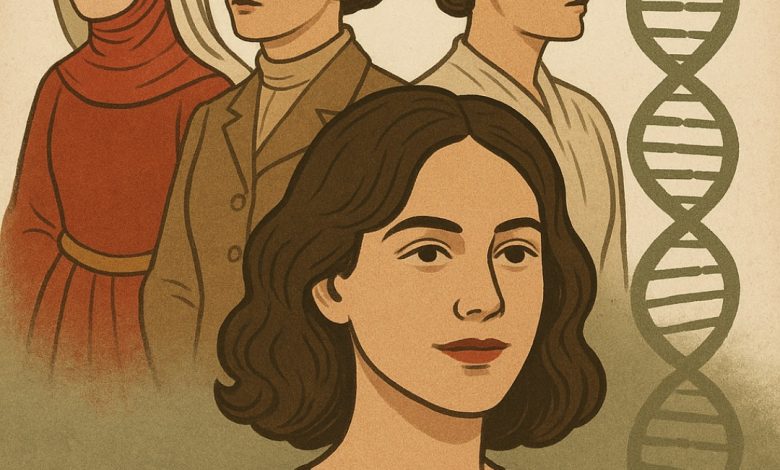
Rosalind Franklin was a physicist who spent hours — nay, years — imaging the structure of the DNA. And her X-ray diffraction picture, Photo 51, was shared by her colleague with his scientist friends without her permission. Within record time after that, they deciphered the double helical structure of the DNA. Watson and Crick received the Nobel Prize for their discovery in 1962.
By then Franklin was no more. She died of ovarian cancer in 1958. People speculate — and I confirm — it was indeed due to the relentless exposure to those X-rays she used in her experiments. The ones that could unmask the convoluted form of the DNA double helix but failed to unmask the inherent deceit that goes into crediting profound achievements, especially by women.
The important thing is the discovery, no matter who discovers it. Science is not at the mercy of the specifics of the scientists. They are, at best, explorers in search of new lands. What is important is the land they discover. The one that would help solve the existing problems of the world. New, better-yielding crops to feed the hungry. Medicines that cure. Machines that make work easier. Alternative sources of energy that help us commute better. Putting people on other planets. Because life must go on, and it should not matter who has to run to make the wheel turn. The position of women in science then, seems eerily similar to that of homemakers.
The internalizing of this methodic neglect became habitual for us. We ingrained these stories of depravity, humiliation, and suppression into our very core. A page torn from a life book, and stuffed into another copy. For fear it would be lost along with our tattered souls. By the time you came about, we had an entire library of slights, spanning a thousand years. We hid it where it was the safest- in our DNA. A story in each coil.
So the next time you catch yourself fuming over something trivial, and someone asks you if it is that time of the month, say, “Yes. That time of the millennium, more likely.” The time you yell. And not worry about your spittle falling in a spray around you. A few casualties are acceptable, if the men who wrote history are to be believed.
Now, for your name. Matilda Joslyn Gage was a suffragist, a writer, and a powerhouse. She documented how women’s achievements were either systematically ignored or attributed to their male colleagues. The Matilda Effect specifically tells how women of science have been Matilda-ed.
There has always been a Matilda around. Mocked, underestimated, silenced, and underappreciated. Told she will somehow always be less — not because they are not okay with her equation being balanced, but if her ‘X’ were to have any value, the ‘Y’ would automatically appreciate to a new, higher value.
I was afraid this would turn into a man-hating rant. And I can see you squirming already. So let me clarify — I don’t hate men. I most positively love quite a few. I happen to live with one of their riders in a plasma-filled bubble. I’m the ‘X’ factor of the ‘XY’ genetic makeup of a fine man. It turns out man or woman, they always need an ‘X’ chromosome to make it alive in this world, as a confused mass of cells that can someday hope to be human.
You, my dear daughter chromatid, are a spitting image of me. And yet, different. We are a generation and several mutations apart. You live on in an ‘XX’ makeup, and your human will get to experience firsthand the second-citizen treatment I have been blustering about. Our equations are different, perhaps. But the struggle is the same.
Let me just end this with a simple observation — the glass ceiling they speak of is made of concrete. And the walls are constantly closing in on us. With each woman who dares to occupy space, maybe just enough to afford her a lungful of air, we manage to stave off the walls for just a while more.
You will need one of their Lil Riders, or several; the baggage, the wisdom, and the pent-up angst of a thousand years to bulldoze through that. I can assure you, however, that the light that streams in from the hole in that ceiling will dazzle you and your rider alike.
And it will be worth the trouble.
Yours truly,
X.
Author’s note/Glossary of terms:
- Spermatogenesis: The process by which sperm cells are produced in the male reproductive organs.
- Chromatin: A complex of DNA and proteins found in the nucleus of a cell, which becomes tightly coiled to form chromosomes.
- Chromosome: A thread-like structure composed of DNA and proteins that carries genetic information. Humans have 23 pairs.
- Matilda Effect: A term used to describe the phenomenon where women’s achievements in science and other fields are often overlooked or credited to their male counterparts.
- Accessory Chromosome: A type of chromosome that is not essential for basic cellular function but plays a role in determining biological sex, like the Y chromosome in humans.
- XX & XY Chromosomes: The sex chromosomes that determine a person’s biological sex. Typically, females have two X chromosomes (XX), and males have one X and one Y chromosome (XY).