

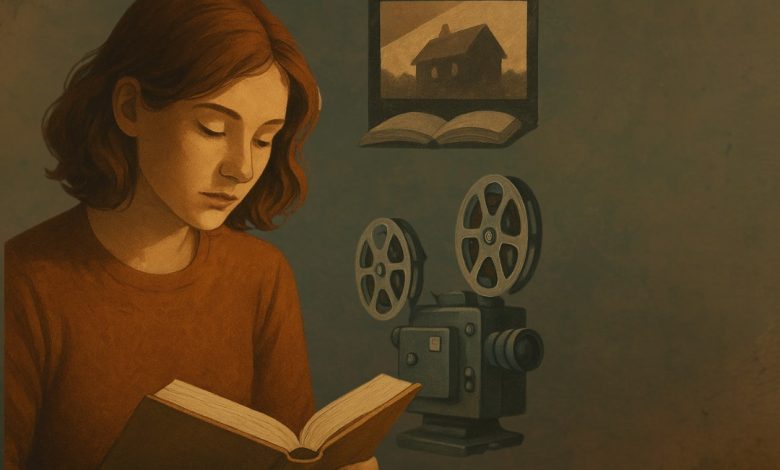
There’s something deeply personal about reading a book. You carry it with you—dog-eared, underlined, sometimes stained with coffee or tears. It becomes more than a story; it becomes a companion. That’s why, no matter how cinematic or well-cast a film is, it rarely lives up to the book it’s based on.
Books offer something rare in today’s fast-paced world: space. Space to slow down, to feel, to connect. You can keep going back to a scene that breaks your heart, sit with a sentence that feels like truth, or pause and just feel what the character is feeling. Movies are beautiful, but they often race against time, trimming out the small, quiet moments that gave the book its soul.
A well-written and touching book grows with and on us. Re-reading it years later feels like catching up with an old friend—familiar, but changed, just like you. No screen adaptation can mirror that evolution.
Some books don’t just tell stories—they stay with you. They become the backdrop to a specific chapter in your life. Maybe you read them on a long train ride, tucked under a blanket on a rainy evening, or during a time when everything in your life felt uncertain. And when you revisit them, they speak to you again, sometimes in new ways. That’s the kind of book The Book Thief is- and remains one of my favourites.
It was made into a beautiful film, yes. Visually haunting and sincere. But the book? The book was something else entirely. It wasn’t just a story—it was an experience. Narrated by Death with a voice so achingly human, it offered a perspective that was philosophical, poetic, and deeply intimate. You didn’t just read about Liesel and Rudy and Hans—you felt them. Their courage, their hunger, their heartbreak. The book gave you time to sit with their grief, to understand their silences, to see beauty in the bleakest corners of war. The movie captured the plot, but the book captured the soul.
What makes Markus Zusak’s masterpiece so unforgettable isn’t just its plot or even its unforgettable characters. It’s the way the story allows space for feeling. Deep, heavy, silent feeling. There’s a rhythm to it—slowed by grief, lifted by laughter, stretched by silence. You find yourself not just reading but dwelling—in the cold basement with Max, on Himmel Street with Liesel, under the falling bombs, between pages of grief and stolen words.
The narrator—Death—is a character unlike any you’ve met before. Far from grim or cruel, Death in this story is weary, gentle, even compassionate. It watches, and wonders. It is haunted not by ghosts, but by humans—their kindness, their cruelty, their contradictions. Through Death’s eyes, we witness not just the horrors of war, but the fierce flickers of light that survive in its darkest corners.
And then there’s Liesel Meminger, the book thief herself. A girl with a hunger for words and a heart big enough to carry the weight of loss, resistance, and wonder. Her journey is stitched together by the books she steals, the stories she clutches like lifelines, and the people who become her world.
The choice of setting—Nazi Germany—is not incidental. It is woven through with hope, with moments of levity, with the stubbornness of human goodness that refuses to die even when surrounded by death.
Years after reading it, you might not remember every event in chronological order. But you’ll remember how you felt. The lump in your throat when Max left. The steady comfort of Hans, the hunger in Liesel’s eyes—for food, for belonging, for meaning. And the narrator’s voice, reminding you softly, that even Death is moved by our stories.
As someone who treasures The Book Thief as an all-time favourite read, the film adaptation felt like a diluted echo of something profound. The book’s quiet power lies in its poetic language, the raw intimacy of its characters, and Death’s hauntingly reflective narration. These elements created a deeply emotional, immersive experience that the film struggled to capture. While the movie had beautiful visuals and sincere performances, it lacked the book’s soul—the slow, tender build of relationships, the gravity of loss, and the flickers of hope amidst despair.
Liesel’s emotional growth, Rudy’s heartbreaking innocence, and Max’s quiet strength were only brushed upon, not deeply felt. The book allowed us to sit with grief, with love, with fear. The film moved too quickly to allow those moments to sink in. Death’s narration, which gave the novel its reflective depth, felt superficial onscreen.
Even though a two-hour film can’t replicate every page—but as a fan, it was like watching a sketch of a masterpiece I once knew intimately. The heart of The Book Thief wasn’t in the dialogue or plot alone—it was in the feeling it left behind. And sadly, that feeling didn’t fully survive the jump to screen.
So as we celebrate World Book Day, let’s remember why we hold onto books like this. Why they outlast their film adaptations, why they outlast trends, and sometimes even the memories of the time we first read them. Because they were there. They were the memory. They comforted us when nothing else made sense. They introduced us to characters who mirrored our pain, our confusion, our resilience.
A good book lingers. A great one changes you -Quietly. Deeply. Permanently.
To the stories that saved us, shaped us, and stayed. Happy World Book Day.