

Bandra was still asleep when Leah left her apartment, the hum of the city muffled beneath a thin
veil of smog. The air was cooler than usual for Bombay’s short-lived winter, the kind of chill that lingered long enough to make the sunburnt skin feel alive again. Leah’s headphones clung to her ears, Coldplay’s Yellow reverberating through her like a private concert. She couldn’t get over their actual concert for which she travelled all the way to Vashi the night previously. She adjusted the volume, lost in the rhythm, her thoughts distant, untouchable. Bombay was her city, the city where the air smelled of faintest hint of the sea breeze. Each step she took towards her car felt as though she was walking through a world that belonged to someone else—an exclusive privileged world.
The streets, still hadn’t recovered from all the ploughing that was being done in the name of development. The perpetual inconvenience was now beyond regretful. The Mars like road conditions, made any form of commute a slippery, unforgiving part of life. The city’s pulse quickened around her. A rickshaw sped by, the driver weaving through traffic like a madman, while in the distance, the Kaali-Peeli taxi drivers shouted bargains to potential customers. She remembered a time, years ago, when she’d taken those rides without hesitation, the wind kissing her skin, her body swaying in sync with the beat of the city. Now, those taxis felt like relics of a bygone era, the street’s uninvited guests.
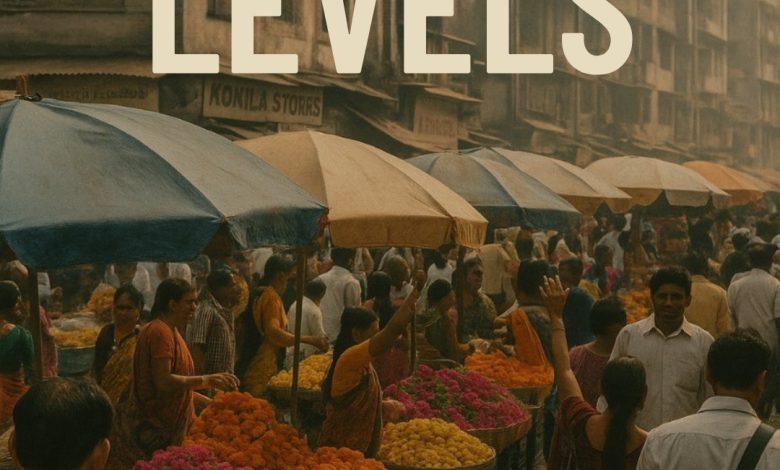
A brief glance at her watch showed the time to be 8:30. The Upper Worli flyover was just ahead. Her eyes flitted to the side—Dadar Market as she drove through it. She looked at the sea of colours and smelled the coriander, the fresh greens, and the flowers that spilled from every corner, crammed into baskets, wedged between bodies. The people moved with purpose, an unspoken choreography of survival and sustenance. Here, life had a different rhythm. The Dadar market was the heartbeat of a city whose pulse thrived at every corner its wildness, the chaos of it, stayed with her. She was from Bandra—an area where the right kind of people lived. The smell of freshly brewed coffee and expensive leather bags marked her days, where the news wasn’t who died but who’s eating where. Yet, even here, the distance between rich and poor felt ever so present.
The sound of honking brought her back to reality. A car was dangerously close to the edge, the man behind the wheel oblivious to the world. He honked again. People on the street ignored him, walking in a manner that bordered on fearless. It was the true essence of a Bombay person—the way they crossed roads without hesitation, as though the traffic was part of the game, a dance with fate, and destiny’s invisible hand.
“The streets will wait for you.”
That’s what Madhurima’s mother always said when they were children. She had crossed streets of her hometown Kanpur tugging Madhurima along always, making sure her daughter was tightly holding her hand in tow, her instincts so sure of the path ahead.
While waiting for the signal to turn green, Madhurima saw a woman cross the road with a casual disregard for her three children behind. The children crossed well enough after the motorists who had an equal dismay for the traffic signals had slowed down. Slowed down, not stopped. In this city, survival was instinctual. Madhurima could still feel her mother’s hands tugging her along, guiding her through the madness of this city, the heat, the dust, and the strange comfort of knowing that it was all a part of something bigger.
She had stopped her scooter at a traffic signal, and she leaned back, closing her eyes. The sun, just beginning to peek through the buildings, felt warm on her skin, reminding her of the early mornings when she was new to Mumbai and used to run on the weekends. Running- something that everyone always seemed to do in this city. Something she only ever did after coming here. She used to dream there, surrounded by the scent of sea salt and the cacophony of sounds around. These sounds dulled the unnecessary voices that called her an “outsider from that state”.
Love stories happened in this city every day—the ones that bloomed in the cramped, anonymous spaces of rickshaws and small cafés, fleeting yet unforgettable. She wondered if those stories, the ones on Bandstand, were as precious as they seemed, or if they were just distractions to keep the city’s residents from remembering that they, too, could disappear in an instant. Millions like her were lonely inspite of being over packed in the city of dreams. Intimacy did not have a pin code in this metropolis.
Her job at a marketing firm was nothing glamorous, but it paid the bills. Every morning, she rode through the crowded streets of Lower Parel, dodging cars and bikers, her eyes on the road but her mind often drifting toward something else—dreams. Dreams that danced in her head like the glistening lights of the city at night.
But there was one thing she didn’t understand: the allure of glitz. In Kanpur, her dreams had been simple—marriage, a house, a secure life. But Mumbai made her think bigger, and one thing she had come to love was the smell of the mall.
Every week, she would find herself wandering into Palladium Mall, an oasis of luxury in the heart of Lower Parel. The sprawling marble floors, the elegant shops, the air thick with the scent of perfume and fresh coffee—it fascinated her.
She would pass by the perfume store, her eyes trailing over the polished bottles, each one gleaming with promise. The scent would linger in the air, a subtle blend of fanciful ingredients. The scent of Mumbai’s richness. It was in contrast to the jasmine and sandalwood, which reminisced her of the fleeting days of her childhood in Kanpur. She would stand there, for just a few minutes, inhaling deeply. It was a small indulgence in a life of hard work and sacrifice, but it made her feel connected to something larger than herself.
One day, she thought, she would buy something from that store. Something nice. Expensive. And she wouldn’t buy it for herself, no. It would be for her mother. A gift to show her that all the miles, all the struggles, all the nights spent in her tiny apartment, were worth it. Something for Maa, who had given up her own dreams so Madhurima could chase hers.
“One day,” she would whisper to herself.
Zakir Khan was a man of the streets, his life etched in the pulse of Mumbai. He had been driving his rickshaw for as long as he could remember, having lived through almost every chapter this bustling city had to offer. His rickshaw, painted in a bright yellow and black hue, had carried hundreds, if not thousands, of stories. As he navigated the narrow lanes, the memories of the chaos and the calm floated around him like the smoke that rose from the street vendors’ carts.
He had been just a young man when the infamous riots of 1992 shook the city. Zakir recalled how the streets were filled with anger and fear. He had been driving his rickshaw that fateful night, when a group of men with rage in their eyes stopped him. A quick word, a tense moment, and he had to hide his rickshaw in the alleys to protect himself. But he wasn’t one to let fear control him. He knew the city, its dark corners and lively edges, and though the riots burned across Mumbai, Zakir kept driving. “No time to get tired in this city,” he had said to himself.
Then came the floods. He remembered the monsoon of 2005 like it was yesterday. Streets turned into rivers, and for days, the city was submerged. But Zakir’s rickshaw never stopped. He waded through flooded streets, helping people out of the muck, offering rides to the stranded, even when the water was up to his knees.
He had lived through the terror attacks, too. When the bombs went off, when the city’s heart bled, Zakir’s rickshaw was there—carrying wounded survivors to safety, ferrying the shocked and the desperate through streets strewn with chaos. It wasn’t just about earning money. It was about service. His rickshaw had been a symbol of perseverance, a silent witness to the city’s tragedies and triumphs. He had never had the luxury of being scared. Every passenger had been a soul to help, no matter the circumstance.
But there was something Zakir could not stand—the younger drivers with their Ola and Uber apps. He watched them race through the streets, trying to earn a quick buck by driving recklessly, speeding through red lights, caring little for the lives they carried. “They think it’s just a job to make money fast,” he muttered under his breath. “This city’s roads are not a race track.” To Zakir, driving a rickshaw wasn’t just about earning. It was about respect—for the city, for its people, for the journey. He had seen the heartbreak and the joy, the pain and the pride, all unfolding through his windshield. The younger drivers, with their new-age apps and flashy cars, were just in it for the numbers on their screens, not the stories on the streets.
Despite his frustration with the newer generation of drivers, Zakir knew he couldn’t afford to retire. The thought of sitting idle in his small one-room home in a crowded Mumbai locality didn’t sit right with him. “Retirement? What’s that?” he laughed. The city moved too fast, and Zakir moved with it. No time to get tired, no time to slow down. As long as the streets kept calling, he would keep driving.
And Zakir Khan, with his kind smile and steady hands on the wheel, knew better than anyone that Mumbai didn’t wait for anyone.
Leah had been desperate. The drive to BKC would be nothing short of unbearable. The roads had barely been passable. She had no patience left to navigate the chaos that was Bombay’s traffic. Her car would be stuck in bumper-to-bumper traffic for what would seem like hours. The sounds of honking, shouting, and the constant screeching of tires on partial roads had been too much. She had decided then—enough was enough.
The pride of belonging to and being from Bombay was slowly fading, a casualty of the chaos the city had descended into. Alongside the crumbling infrastructure, there was a growing tide of hatred—a deepening animosity against people for countless reasons. Bombay, once a resilient metropolis, had always risen like a phoenix from the ashes, lest it dies. Perhaps, in time, it will revive, shedding its bitterness and once again become the vibrant, loving city it once was.
The rickshaw was a different world altogether. Even in her bubble of privilege, Leah had to travel in one today to prioritize sanity over comfort. As soon as she had stepped into the rickshaw, the weight on her shoulders had lifted. She had let out a long breath, feeling the tension drain out of her body
She often found herself in them on random, unplanned days. On this particular one, the rickshaw driver, a middle-aged Muslim man with an eager face, darted through the heavy traffic. Zakir’s rickshaw had swerved and glided through gaps in traffic, threading its way like a needle through the city’s clogged arteries.
The streetlights blinked, their orange glow casting long shadows, painting the chaotic scene in an eerie light. Leah had glanced at her watch. Almost 9:00 p.m. Her meeting at BKC couldn’t be delayed much longer.
As the rickshaw slowed at the next traffic signal, Leah’s eyes caught sight of a figure on a scooter pulling up beside her. From the corner of her eye, she noticed a girl at the traffic signal, her clothes not too stylish but her eyes fierce with something Leah had never had to face. This girl had the same glint in her eyes as Leah did when she saw Coldplay perform. But her destination was different. Her world was different.
Leah thought of her as a middle-class girl from a small town. The girl would have stepped off the local train with the same breath of fear mixed with excitement, stepped out into this bustling, loud, alien world where every step felt like a leap of faith. The girl had stopped her scooter next to the rickshaw, adjusting her helmet and glancing at Leah with a distracted smile.
To Madhurima, this fancy-looking girl in the rickshaw had been one of those people who seemed to belong to a different world, but one she could never quite touch. The people who actually bought things at the Jio Mall, those who mingled in the “cool” part of town, the city’s elite. Leah had always seemed too polished for the likes of Madhurima—her clothes, her demeanor, the way she carried herself—everything about her had shouted confidence.
“Stuck in traffic too?” Madhurima had asked, her voice light but with a hint of frustration.
Leah had nodded, unable to mask the irritation in her eyes. “Tell me about it. I don’t think I’ll ever get used to this,” she had replied. She had felt a sense of camaraderie in that moment, a small connection to someone who, like her, had had enough of the city’s grind.
“You never do!”, Zakir chimed in.
Just then, a sudden sound had cut through the evening air. The deep rumble of a large bus approaching rapidly from behind. The BEST bus had appeared out of nowhere, its headlights blinding and its horn blaring. Zakir had tensed at the sight of the bus, his eyes widening in alarm.
In that instant, time had seemed to slow. The rickshaw had swerved sharply to the left, jerking Leah from her brief moment of calm. Her heart had skipped a beat. There had been no time to react, no time to do anything but hold on. The driver’s frantic voice had shouted something unintelligible, but Leah couldn’t focus on it. She had turned towards this girl on the scooter, who was now caught in the same immediate danger. Madhurima had looked back, her face a mixture of surprise and fear, as she had watched the oncoming bus, unable to react fast enough.
The city’s frantic heartbeat had quickened, the pulse of Bombay rising like a storm.
And then, it had happened.
A massive crash—metal scraping against metal—was the last thing Leah had heard before everything had gone dark.
The world around her had exploded into chaos. The screech of rubber burning against hot asphalt. The crash of the rickshaw as it collided with the bus. The sound of twisting metal, and then the sickening, thudding silence.
Madhurima had screamed, her voice drowned out by the blaring of horns and the rush of noise. But it hadn’t mattered. The city had continued, its rhythm unbroken by the tragedy unfolding on the road.
In the aftermath, the streets had swallowed the accident as they had swallowed so many others— nothing new to the city. People had gathered around the scene, as they always did, murmuring under their breath, their eyes flicking over the wreckage like it was just another news item to be forgotten by morning. Seven lives would be declared lost and forty-two be counted as injured for the sake of official data and news channels.
The rickshaw driver had been twisted at an unnatural angle, lifeless. His body had been a broken doll, no longer a part of the living, and the girl on the scooter—Madhurima—had been sprawled on the ground, her eyes unblinking, her face frozen in that moment of time, untouched by the frenzy of the city.
Leah… Leah too had been gone. Her body had no longer been a part of the world she had known so well—the city of privilege, the city of dreams, the city where people had lived in their small, compartmentalized worlds, too separated to feel the heat of each other’s lives.
And then, the great leveller had done its work. In this city, human life value was reduced to just
another crowd statistic.
The city would continue. It always did.