


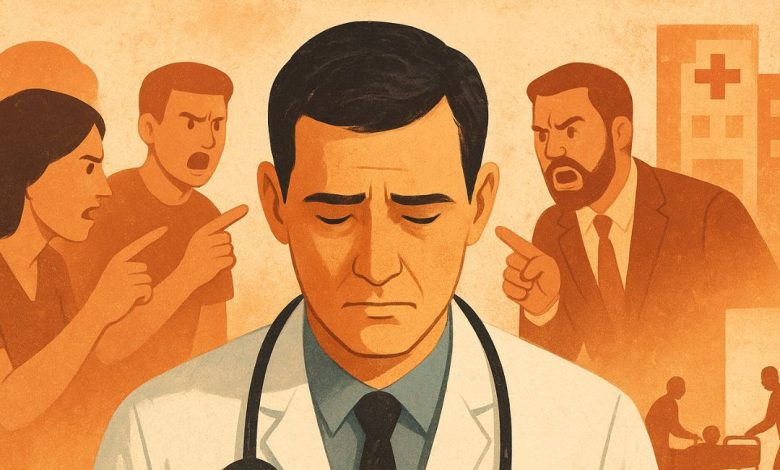
On November 13, 2024, Tamil Nadu: Dr. Balaji Jagannathan, a senior oncologist at Kalaignar Centenary Super Speciality Hospital, lay bleeding from seven stab wounds inflicted by the son of a cancer patient. Despite providing six cycles of chemotherapy, the woman’s end-stage cancer had metastasized. From her hospital bed, the patient blamed her doctor: “If the doctor hadn’t failed his duty, I would not be this ill.”
On June 7th, 2025, Goa Medical College, state Health Minister, Vishwajit Rane’s relative came to ask for a B12 injection in the emergency department. However, the relative was asked to visit the outpatient department instead. After the health minister received a complaint regarding the same, he publicly berated the CMO and said, “Keep your hands out (of your pockets) when you are standing in front of me. I generally don’t lose my cool, but you have to behave… Remove the mask when I am speaking to you.” He then ordered CMO Dr. Rudresh Kuttikar’s suspension.
These incidents are to name a few. However, they expose a disconcerting paradigm: doctors are always convenient scapegoats. Often, overwhelmed hospitals, inadequate resources, and impossible caseloads create conditions with not-so-favourable consequences. Families lashing out at individual doctors seem fitting, politicians score points by publicly shaming them and society treats them as expendable targets for collective frustration. The outturn is evident, dehumanization of doctors while expecting them to perform miracles.
More than a century ago, a medical journal cited: “No physician, however conscientious or careful, can tell what day or hour he may not be the object of some undeserved attack, malicious accusation, black mail or suit for damages….” The statement stays staunch today.
As we move further, let us unravel the unruly system as a whole. Treading through the numbers: The World Health Organisation’s standard Doctor to Patient ratio is 1: 1000, but India’s data shows 1 doctor for approximately 1,800 patients. The healthcare budget (GDP) remains below 2% despite WHO’s standard of 5%. The Indian Medical Association has reported that 75% of doctors face verbal or physical abuse in hospital premises and fear of violence was the most common cause for stress for 43% doctors.
With infrastructural failure rising, there are countless breakdowns. It is well known that doctors, especially residents face up to 36 hours of work shifts without any breaks, and it is normalized, despite hospitals claiming to have official working hours established. Broken equipment, insufficient medicines, overcrowded wards seem to be common in every other hospital despite the health ministries supposedly aiding to them.
Under sourcing creates a vicious cycle in healthcare. The absence of social workers, support staff, and counsellors is common, stripping healthcare of the human support that makes it patient-centered and effective. These professionals complement doctors and nurses by addressing the emotional, social, and practical aspects of illness. With limited medical equipment, diagnostic delays occur, and patients face uncertainty and frustration, which erode confidence in both the diagnosis and treatment plan. A related problem is the shortage of specialists: entire districts are often left without cardiologists, neurologists, and other experts, forcing available doctors to shoulder care outside their specialization and adding further pressure to an already strained system.
Families entering this fractured system find themselves caught between their loved one’s suffering and an institution unable to meet basic needs. Extended waits without updates transform concern into panic, while doctors racing through impossible caseloads offer hurried explanations families struggle to understand. Due to communication gaps, families decode medical procedures alone, often arriving with television-inspired expectations or internet research that conflicts with medical reality. When treatments progress slowly or complications arise, the absence of proper counselling leaves families feeling betrayed rather than informed about medicine’s uncertainties. Cultural and linguistic barriers compound these misunderstandings, as overwhelmed staff dismiss traditional concerns or fail to explain procedures accessibly.
This dysfunction creates a medical culture increasingly defined by fear rather than care. Each attack on healthcare workers teaches doctors that vulnerability is dangerous and connection risky. Medical practice becomes self-protection: conversations focus on legal safety over emotional support, documentation takes precedence over listening, and physical distance replaces therapeutic presence. The most talented physicians abandon their desired fields or emigrate entirely, seeking environments where healing is met with respect rather than suspicion. What emerges is healthcare where human connection essential to healing has been sacrificed because caring has become professionally hazardous.
When we come to resolutions, we cascade down our way: starting with immediate and obvious ones. What does the system need to do? The government, corporations, and administration must recognize that health is an investment, not an expense, for individuals and countries alike. Raising investment in healthcare, for example in infrastructure development, would show progress in leaps and bounds.
Primary care, as the first level of contact between individuals and the healthcare system, needs to be present and well-functioning. Patient support services like social workers and counsellors create a cushion of safety, solace, and an emotional outlet for those who need it. These professionals complement medical care and prevent the communication breakdowns that fuel hostility.
Workflow redesign addresses the patterns we’ve identified: emergency wards and their life-or-death scenarios create fragile situations that crumble too often. Medical administrations must implement strict triage systems with proper patient education, ensuring families understand wait times and procedures from the moment they arrive. Information desks staffed with multilingual personnel help frenzied patients assess and navigate situations more effectively. Clear communication protocols between doctors, staff, and all healthcare workers need to be streamlined and continuously refined.
The legal framework requires equal attention. Strong hospital security with clear protocols can keep perilous situations at bay while addressing patient concerns rather than dehumanizing them. Fast-track courts for medical negligence with healthcare expertise, combined with legal protection for doctors, while ensuring accountability, will make people reconsider barbaric responses to medical uncertainty.
Patients and families can significantly influence the healing process. They should understand hospital policies thoroughly. Expressing concerns respectfully and specifically allows doctors to address issues effectively, and when explanations seem unclear, requesting written instructions ensures clarity. Language barriers require official interpreter services, not assumptions. If problems arise, they should use complaint mechanisms before conflicts escalate.
Building an understanding means recognizing the human element in healthcare. Learning about doctors’ extensive training and expertise helps establish trust. Appreciating medical complexity and the limitation of medical science prevents unrealistic demands. Most importantly, recognizing doctors as human beings under stress, rather than infallible beings, creates space for compassion and commiseration.
So, what can doctors do, in the midst of this? Doctors must become excellent, concise communicators, mastering the art of gathering relevant information quickly while practicing empathetic responses. This allows them to build clear boundaries while making patients feel safe. Cultural competency becomes essential. Understanding regional health beliefs, addressing familial concerns proactively, and respecting traditional practices alongside modern medicine.
Ending consultations with clear next steps and realistic timelines reduces unnecessary liability while managing expectations. However, before society learns to view them as people, doctors themselves must step back and ensure work-life balance. It would be strange if those who prescribe wellness don’t practice it themselves. Acknowledging burnout, seeking mental health support, and coordinating with management on patient flow thresholds aren’t signs of weakness; they’re professional necessities. Toxic team dynamics must be eliminated, and communication with peers, whether doctors, nurses, or support staff, becomes crucial for both patient care and personal survival.
The dehumanization crisis plaguing healthcare isn’t about individual failures; it’s about a system that has forgotten its fundamental purpose. Our shared vision should be transforming healthcare into a model where modern medicine meets the ancient wisdom of healing.
The transformation begins with small steps: a government official ensuring adequate staffing, the administration overseeing safety and security, a doctor ensuring that his duty doesn’t induce distress, a patient preparing respectful questions instead of demands. These individual actions accumulate into systemic change. The question isn’t whether we can afford to make these changes, but whether we can afford not to.