


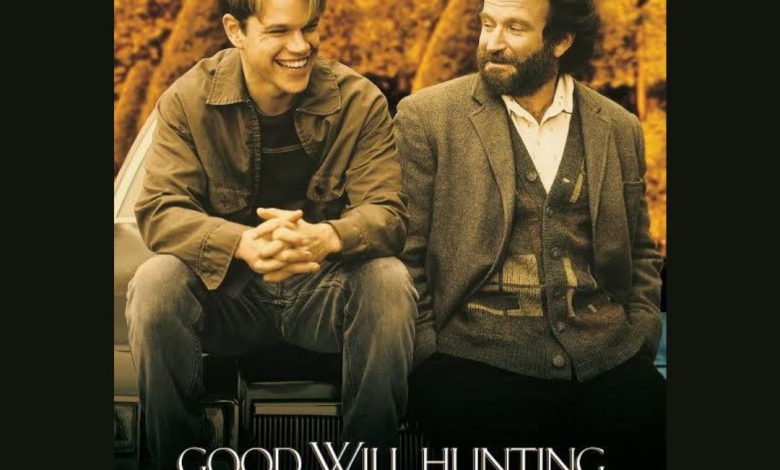
There is something quietly unsettling about watching genius sabotage itself. Gus Van Sant’s Good Will Hunting, written by Matt Damon and Ben, remains far more than the inspirational success story it is often remembered as. Beneath its accessible surface lies a layered meditation on trauma, emotional survival, and the difficult work of change, themes that resonate deeply for those in medicine who spend their lives witnessing human struggle at close range.
The film follows Will Hunting (Damon), a twenty-year-old janitor at MIT who spends his nights drinking with his childhood friends in South Boston, getting into fights, and drifting between construction jobs. His world is anchored by Chuckie (Affleck), loyal, rough-edged, and painfully aware of how limited their future seems. Into this world steps Skylar (Minnie Driver), a brilliant and emotionally open Harvard student who challenges Will’s belief that closeness only leads to pain. Looming over everything is Professor Gerald Lambeau (Stellan Skarsgård), a celebrated mathematician who recognises Will’s extraordinary ability after he anonymously solves a near-impossible problem left on a blackboard. When Will is arrested after assaulting a police officer, Lambeau arranges his release on the condition that Will study mathematics and attend court-mandated therapy under the care of Sean Maguire (Robin Williams), a community college psychologist grieving the death of his wife.
Damon plays Will not as a romanticised prodigy but as someone fundamentally terrified of vulnerability. Years of abuse and abandonment have taught him that attachment is dangerous and that the safest response is to strike first. His job at MIT is not simply practical; it is psychological positioning. He places himself inside the world that represents everything he could become while remaining invisible to it. He can prove his superiority without the risk of belonging.
The film is at its sharpest in its portrayal of Will’s resistance to therapy. He dismantles one therapist after another, analysing their lives, mocking their methods, and turning each session into a performance of intellectual dominance. When he finally meets Sean, Will attempts the same tactic, launching into a confident but deeply inaccurate analysis of Sean’s life based on a painting in his office. The point is not whether he is right, because he is not, but that whoever controls the room cannot be hurt.
The screenplay is often deeply effective, especially in its handling of class, loyalty, and male friendship. The South Boston scenes feel lived in and unforced. Yet the writing sometimes betrays its own eagerness to sound brilliant. The well-known bar scene, where Will humiliates a Harvard student by dismantling his borrowed arguments, is both satisfying and faintly uncomfortable for that reason. Some monologues stretch beyond natural speech into rhetorical display, but the emotional core remains steady.
Professor Lambeau’s role introduces another tension. He genuinely wants to help Will, but his desire is inseparable from his own unfinished ambitions. He pushes relentlessly, convinced that unused talent is a moral failure. The film wisely refuses to frame this as either heroism or villainy. Instead, it presents intervention as ethically complicated, especially when it collides with autonomy and emotional readiness.
Will’s brilliance becomes not an escape from trauma but one of its most sophisticated defences. His history of abuse, quietly revealed through court records and offhand remarks, informs every choice he makes. Nowhere is this clearer than in his relationship with Skylar. When Skylar tells him she loves him, he starts a fight and storms out. He abandons before he can be abandoned.
Will’s trauma emerges most painfully in his relationships. As his bond with Skylar deepens, he dismantles it. When she tells him she loves him, he begins a fight and walks away. He abandons before he can be abandoned. In one of the film’s most unsettling moments, Will solves an extraordinarily difficult mathematical problem and then burns the solution in front of Lambeau, dismissing both the work and the man as beneath him. The act is not simple arrogance. It is pain transformed into cruelty, intelligence used as a weapon to preserve emotional distance.
His transformation does not arrive through argument or opportunity, but through something quieter. Sean’s patient presence and emotional honesty slowly dismantle Will’s defences. In the film’s most powerful scene, Sean repeats a simple sentence, “It’s not your fault,” until Will finally breaks. The moment works because it is patient. Sean does not try to fix Will. He creates a space in which Will can finally stop protecting himself.
Just as importantly, Will forces Sean’s own growth. Grieving his wife and withdrawn from the academic world he once shared with Lambeau, Sean has settled into emotional stasis. Through Will, he confronts the ways he has used love as refuge and avoidance. By the end, he prepares to live again. Their relationship reshapes them both.
Only after this transformation does the film offer its quiet hope. Will leaves for California to find Skylar. Sean prepares to re-enter the world. Lambeau releases control. The ending may be tidier than life, but its optimism feels earned.
For doctors and medical students, the film’s psychological undercurrents are particularly striking. Will’s primary defence is intellectualisation, the unconscious use of cognition to avoid emotional pain. Nearly every major action he takes can be understood through this lens. His verbal dismantling of therapists, the barroom takedown of the Harvard student, the casual cruelty toward Lambeau, even the calculated destruction of his relationship with Skylar are not acts of confidence but of fear. From a psychological perspective, these are classic trauma responses: control in place of safety, superiority in place of attachment, intellect in place of intimacy. Will does not leave Skylar because he does not care. He leaves because he cares too much, and caring exposes him to the risk of loss. His mind becomes the fortress that keeps him alive but also keeps him alone. In clinical practice, we recognise this pattern constantly: the patient who debates every recommendation, who reframes vulnerability as weakness, who uses knowledge as armour. Healing, the film suggests, begins only when that armour is no longer necessary.
The film also captures the ethical tension between intervention and autonomy. Lambeau forces treatment because he believes he knows what is best. Sean chooses presence over pressure. Both want to help, but only one creates conditions in which healing becomes possible. In medicine, we live inside this tension daily: when to push, when to wait, when to insist, when to listen.
Perhaps most importantly, the film reminds us that intelligence and achievement do not protect against trauma. Many of the most capable people we encounter in medicine carry wounds that skill and success merely disguise. Healing rarely begins with solutions. It begins with trust, with patience, with the willingness to sit beside another person’s suffering without trying to control it.
For clinicians in training and in practice, Good Will Hunting is worth a watch or maybe even two. Not for its famous lines or its mathematical feats, but for its rare honesty about what healing actually requires. It is a film that understands that change is not the triumph of brilliance, but the courage to be seen, and that may be the most valuable lesson any future physician can take with them into practice.