

From Academic excellence to Literary Accolades: Leadership lessons from different life stages and phases

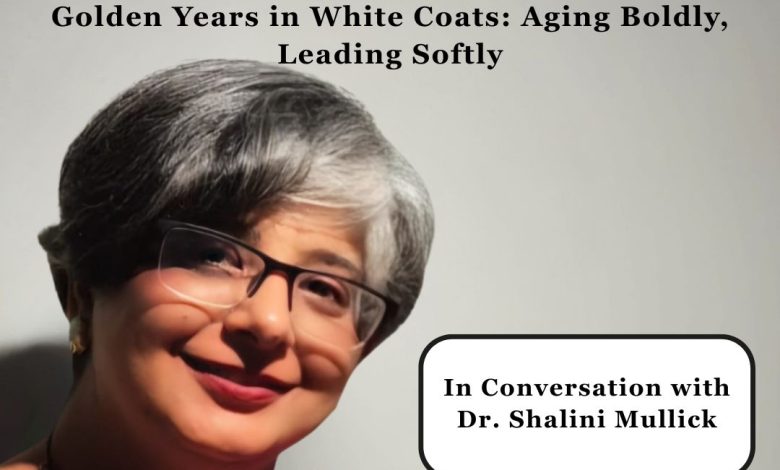
In Conversation with Dr. Shalini Mullick
“Between stimulus and response, there is a space. In that space is our power to choose our response. In our response lies our growth and our freedom.”
— Viktor E. Frankl
For Dr Shalini Mullick, this quote encapsulates numerous lessons in life, leadership, learning and living.
In a profession known for long hours, clinical precision, and often unforgiving standards, the voices of seasoned women in healthcare are rarely centered. Even less so are their experiences of aging, evolving, and reinventing.
This month in Her Shift, we spotlight Dr. Shalini Mullick, a senior pathologist, department head, and a fierce advocate for gender sensitivity in healthcare leadership. Through her candid reflections, we explore what it truly means to thrive, develop and grow not just during our training and early career years, but also later.
Meet Dr. Shalini Mullick
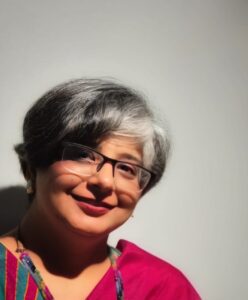
A graduate of Lady Hardinge Medical College, Delhi, Dr. Shalini Mullick holds a specialization in Respiratory and Thoracic Pathology. She currently heads the Pathology Department at the National Institute of Tuberculosis and Respiratory Diseases, a central government-run apex healthcare institution.
Her career spans top-tier medical institutions like St. John’s Medical College, Columbia Asia, and SRL Labs, where she has donned the roles of teacher, leader, researcher, and administrator. She is also a celebrated literary voice, with three published books and international recognition. Her novel The Way Home, which is set in a hospital, was awarded the IGF Archer Amish Award, which is one of the largest literary prizes globally.
Her Shift: A Deep-Dive Interview with Dr. Shalini Mullick
Q1. You’ve had a remarkable journey through medicine. Let’s start at the beginning. What drew you to this field?
“Medicine was always my calling but the real shaping happened at Lady Hardinge. Being part of a 130-woman batch taught me early on that there is no one version of womanhood. Class, background, language, every factor changed the way women experienced the same space. That stayed with me.”
Q2. You chose pathology as a specialty. Was that a strategic decision?
“To be honest, it was part preference, part practicality. I believed pathology would allow a better work-life balance which is something women are often conditioned to seek. Only later did I realize how much that belief was shaped by society, not just personal ambition.”
Q3. What are the unique challenges and advantages of being a woman in a leadership role in healthcare today?
“It’s about striking a balance between empathy and accountability. Women are often expected to be endlessly accommodating, but leadership requires boundaries, too. I’ve learned to say no when needed and to mentor younger women to do the same.”
Q4. How has aging, especially going through perimenopause, impacted your leadership and professional rhythm?
“A woman is not separate from her biology. Yet, they are taught to be silent about puberty, periods and menopause. Perimenopause, for instance, isn’t just physical, but also emotional. For me, it has brought intense fatigue and a feeling often ofbeing overwhelmed. And I realised that this is There were days I couldn’t think clearly, or I was overwhelmed for no reason. And I realized: this is happening to thousands of women silently.”
“So, I try to lead with awareness and empathy. I tell my juniors, it’s okay to take a break. Period pain can be limiting, and we should be able to talk about it and give ourselves the breather that we need. We don’t need to ‘power through’ everything.”
Q5. You’ve written three books. How did that journey begin, and how do you balance your medical career with your writing?
“It began with an urge to express what I couldn’t say out loud. Writing became a safe space. It helps me process, reflect, and reclaim parts of my identity that medicine sometimes sidelines. But my core remains rooted in healthcare.”
Q6. You often speak about gender-sensitive leadership. What does that look like in real terms?
“It’s small things – asking instead of assuming. Letting someone say ‘I’m not okay’ without guilt. Questioning why certain policies still punish motherhood or menstruation. It is about showing up for other women, teaching them to self-advocate. True equity isn’t in the rulebook, it’s in daily language, timing, tone, and trust.”
Q7. What role has mentorship played in your journey, and how do you mentor now?
“I had very few mentors. Most advice came from male seniors or women who had to ‘tough it out.’ Now, I try to be the person I needed when I was younger. I tell younger women that rest is not laziness, ambition is not arrogance, and softness is not weakness.”
Q8. Outside the hospital, how do you find balance as a mother, a mentor, and a woman?
“I’m more grounded now. With age and experience, I have learnt that I need to look out for myself. That I cannot pour from an empty cup. I have become particular about my me time-exercise, reading and writing. I don’t try and do it all; instead I am happy to delegate chores so that I can spend meaningful time with my children.
Q9. You’ve received multiple awards, including the Archer- Amish Award, UNFPA Laadli Award and the Sarojini Naidu Award. What do these recognitions mean to you?
“They’re not just personal wins, they’re collective wins for stories and storytelling, especially those with women at the centre. Every time a woman tells her truth and is heard, the system shifts a little.”
Q10. Finally, what would you say is your shift right now?
“Letting go of proving. Embracing pace over pressure. Owning my story without explanation. This season of my life is quieter, but stronger. I’ve stopped asking for permission to exist fully and that’s the biggest shift of all.”
Editor’s Note:
As we age, we aren’t disappearing, we’re deepening. Dr. Shalini Mullick is proof that there’s no expiration date on ambition, identity, or creativity. Her voice urges us to expand our definition of success and to make space for the slower, softer, wiser seasons in our lives.
Know a woman in healthcare whose story should be told?
Nominate her here → https://forms.gle/XmEQ13gMphqvx1r76