

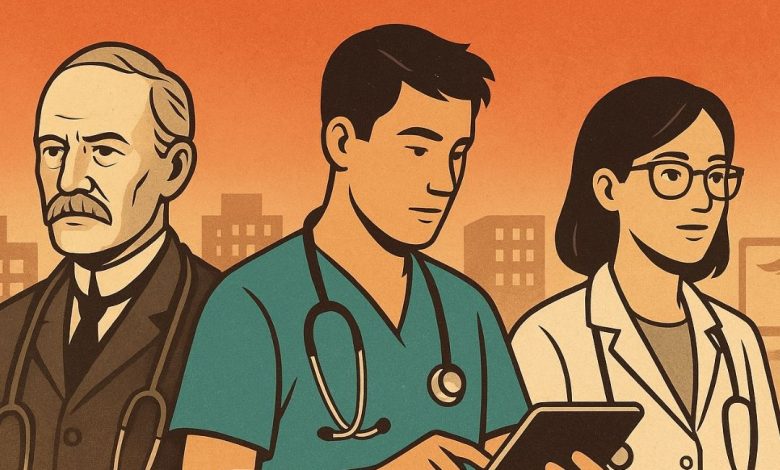
‘MBBS is a calling, son. Go for it.’ How many of us have heard this phrase when we left the realm of carefree schooling and entered the medical realm, with a sea of knowledge waiting to be learned, and many more to come every new day? It is felt among the medical fraternity that doctors’ attitudes towards the profession have undergone a wide array of changes. Let us take a trip all the way back to the 18th and 19th centuries, when the concept of modern medicine was emerging.
The word ‘Resident’, which is thrown at all Postgraduates undergoing their specialty training, wasn’t the case back then. Actually, Dr. William Osler at Johns Hopkins Hospital called the training programs residencies because the trainees were all staying in the hospital, 24 hours a day, 7 days a week, until their course ended, so that they could learn by sheer immersion, a concept which still stands to this day. The members of the Silent Generation had a strict, disciplined, and authoritative approach to medicine, with a military-like hierarchy and loyalty to one place of work as the word to live by. Medicine, for them, was not a list of systems to learn or a series of tests to perform, but a higher calling, prompting them to live and die by their work, with an almost nonexistent work-life balance. At that time, the technology was very limited, so they relied entirely on their clinical expertise and conducted their careers on paper.
Sound was introduced in cinemas, and the Baby Boomer generation, from the 1900s to 1960s, had a different revelation. They were also hard-working and committed. Competition increased as the number of doctors grew. No one wanted to be left behind. They strongly believed in paying dues to society, so diversification began. While loyal to their workplace, private practices became popular and are still common today. Autonomy grew, moving doctors away from a God Complex toward being part of the community. They were late but eventual adopters of digital health, analyzing data and clinical signs. Even then, work-life balance was still far off.
The late 60s brought Generation X doctors, who started asking questions. They challenged strict hierarchies, lack of work-life balance, and favored less didactic speech. Salaries increased. For them, medicine was not just a calling. It was a service, but also became a business. This generation embraced technology, with EMR and the Internet bridging analog and digital medicine. They valued competence and efficiency over mere hospital hours. Inflation brought the need for flexible schedules and started to break rigid systems.
A generation of Millennials appeared in the decade where neon dominated the background, and so did their technology. They started being the tech-savvy crowd, opting for flexible hours. The need for collaboration was only superseded by an intrinsic will for mentorship. They created evidence-based structured guidelines for the treatment of diseases, and so on and so forth. Equity and feedback became more than catchphrases for them, morphing into a sign of their livelihood.
At the far end, Generation Z doctors and medical students, who grew up around smartphones and laptops, became more in touch with instantaneous results rather than actual waiting. They are also aware of the concept of burnout and started prioritizing mental health, unlike the generations before. Gone were the days of long lectures, and short, focused high-yield concepts became the new norm.
The poem The Brook by Alfred Lord Tennyson had these recurring passages:
For men may come and men may go,
But I go on for ever.
This is the same for the medical fraternities, as we lived the same life our forefathers lived, even though their teachings were the gospel of the moment, becoming obsolete the next moment, akin to a sheep’s life in lion’s clothing. While not actively exercising the need for permanent stay or a strict hierarchy like the early days, we still pride ourselves in burning out, saying that the dark circles under our eyes are war scars, and showing off sleeplessness like it is something to be extremely proud of. We still have places where people work for almost fifty hours on end, only saying that it is part of a ‘Hustle’, the Hustle being an early grave. While Mental Health awareness is present, it is still considered inferior among Health Professionals to actually use it.
So, what will the future hold? Artificial Intelligence? 3D organs? A 9-to-5 Medical Job? It is uncertain for now. As the phrase goes, the only constant thing in life is change.