

Driving Them Crazy: A Woman’s Survival Manual on Indian Roads

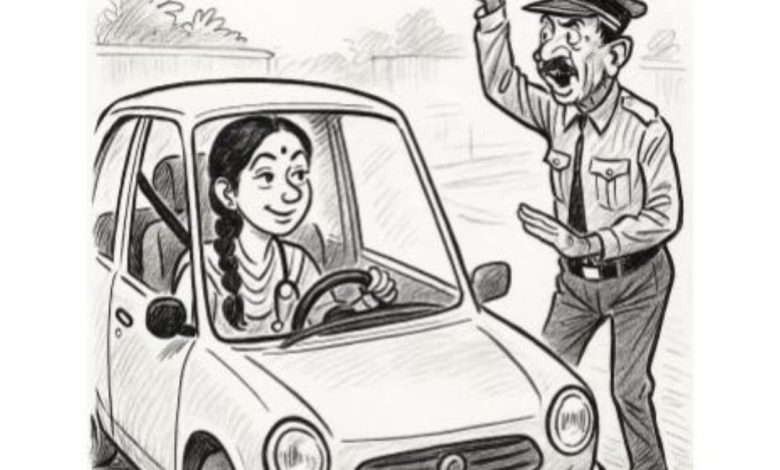
The watchman was doing exactly what any of us would expect him to do in broad daylight — snoring aloud on his rickety chair. I believe the regular Watchman Uncle tribe can sense the absolute security that a commercial building housing a bank and a jewelry shop brings by default.
I also believe they can sniff out a woman driver from miles away. What else could explain his sudden jump wide awake — or his frantic rush to direct me to park ‘properly’ in a space that was an encroachment on the main road?
Like a veteran orchestra conductor, he waved me into a slot right in front of me — no other vehicles within five feet on either side. The only way I could’ve blown this, even without his instructions, was to intentionally speed, run him over, and aim to crash into the jewelry shop. I clenched my teeth, swallowed the shreds of self-respect that had seeped through, and nodded.
“He wouldn’t have done this little dance if you were behind the wheel,” I muttered to my brother.
“You’re taking it too far. The poor guy was just doing his job.”
Perhaps he was. And I trust he does it well — in spite of his siestas. What I’ve never understood is why so few seem to trust us (read: women drivers) to do our job well.
Will we ever view driving as a gender-neutral activity?
Case in point: why are we ‘women drivers’ and not just drivers?
Women constitute only 6% of all drivers on Indian roads, says a Delhi-NCR survey. That’s even more skewed than the worst sex ratio in Indian history.
What explains this chasm? Is it a woman’s inability to multitask — navigating traffic in the wrong direction, around cattle, potholes, and loudspeaker-blaring processions? You know, the multitasking which men are obviously great at.
Or do we blame our rudimentary skills on abiding by rules? After all, women have never had to follow too many rules, while their submissive male counterparts peacefully follow society’s long list of dos and don’ts, eh?
Or maybe society fears our hot tempers? Surely, if more women drove, road rage would skyrocket. Because we’re so bad at managing our emotions.
While gender-specific stats are scarce in India, one survey shows women drivers are involved in about 14% of total accidents. Yes, more than their 6% representation in the vehicle-driving department. But let’s also mention that most serious and fatal accidents involve men. Women cause more minor ones. [But we won’t say that out loud. That’d sound defensive!]
Even researchers say men are better informed about traffic rules than women. Fair. We do have our work cut out for us. Why, then, I wonder, are most traffic offenders male? Surely not because they’re offenders by nature — that would be stereotyping.
In 2024, a driving campaign in France called Drive Like a Woman was launched — after it was found that 84% of fatal accidents were caused by men. Women were eight times less likely to cause an accident. Could we ever say that here in India, without sarcasm?
Will Beti Bachao, Beti Padhao ever graduate to Beti Gaadi Chalao?
Don’t we all know one woman (likely in our own home — could be us too) who went to driving school but never gave the test? She’ll say, “Oh, I can drive… but I’m out of practice…” Her voice invariably trails off at this point. Or worse, it is drowned in laughter from her husband or another family member. Often a woman.
Unsurprisingly, these women are also the ones who have minimal say in decisions — finances, kids’ future, vacation plans. Except dinner menus. Basically, anything requiring her to claim the driver’s seat. And don’t even get us started on those mothballed jokes about backseat driving.
How is it that men will be men sounds infinitely cool, but women will be women makes us sound clueless at best and retarded at the worst?
Some of the most badass drivers I know are women. And to the men who manage to be average drivers — kudos! Driving is a life skill. If you can do it without hurting others (the same applies to cooking), we promise not to judge you. You don’t get to judge us either.
Make no mistake — I’ve met many good men in my bumpy journey as a driver (who happens to be a woman) on Indian roads. Men who’ve helped me out of tight spots. Who’ve lifted parked bikes blocking my path — while their owners smoked nearby on their Kabir Singh–stickered bikes.
A particularly gifted gentleman once helped me steer my car wedged between two lorries — with barely an inch to spare — in a mathematically accurate parking feat that could shame Pythagoras. Then there are the Samaritans who stop to help pink auto drivers or report shady cabbies. My tribe has many such men on our list of gratitude.
But now, we expect logic to prevail — and for everyone to toss out the rusted stereotypes through their power windows.
If you see a car crawling at snail’s pace on an empty highway, don’t assume the driver’s a woman. It’s likely a middle-aged man, phone glued to his ear, taking milk orders from his wife. Be patient — he’s trying to process her request while navigating the ‘Drive Slow, Work in Progress’ sign that seems to pop up at alarmingly regular intervals, almost like a milestone. Honk if you must, but he’ll only pick up speed once he’s off the call. And then forget whether she asked for full-fat or skimmed milk.
To the enlightened men nodding at this rant, and the women whispering “soul sister” in their heads — here are a few things we could work on:
- Strict penalties for gendered road harassment — honking intimidation, verbal abuse, stalking, tailgating, lane-bullying, or catcalling. (Maybe even subsidized dashcams for women. Bonus: helps with false allegations too!)
- 24×7 helplines/apps to report on-road harassment. Some exist — like Delhi’s Himmat app.
- Women-friendly infrastructure — well-lit roads, safe restrooms on highways, secure parking. (With trained watchmen who don’t have mini-seizures every time we park.)
- Licensing reform — gender-neutral testing, zero tolerance for harassing instructors. More women instructors wouldn’t hurt.
- Support for women in ride-hailing services — pink autos, women-only cabs, and training for commercial driving.
- Financial incentives — insurance discounts or schemes for first-time women drivers.
- School education — teach traffic rules and respectful road behaviour, not just punishment charts.
- Normalise women everywhere — trucks, buses, autos — not just hatchbacks.
“Driving liberates a woman,” said Irrfan Khan in the Hindi movie Piku (2015).
I believe it does. Once we, as a society, shift the cultural narrative.
A good way to begin would be to install an automatic gear-changing system in our thoughts — so that we can slow down and reflect upon what we were about to say each time we decide to dismiss shoddy driving for being so because of a ‘woman driver.’
If your wife/mother/sister/colleague drives daily and still hands over the keys to you just because you’re uncomfortable when she drives — the issue, dear reader, may NOT be her driving skills.