


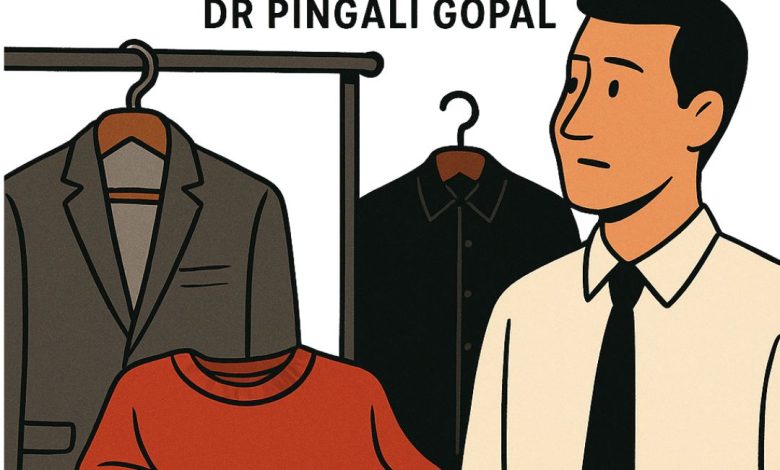
For the first twenty-five years of my life, particularly during my pre-marriage and financially struggling college days, clothes generally meant a cloak over the body primarily to prevent others the embarrassment of seeing an unclothed aspiring doctor. My wardrobe was made of the barest essentials in both quality and quantity. During one glorious period of my postgraduate days, we used to have a washing and ironing service in our hostel. The used clothes were placed in a bucket outside the room at night. Mysteriously, by morning, the clothes would disappear as a person collected, washed, and ironed them before placing them back in the same spot the next day. We never knew the name or appearance of the person who used to materialise with the earliest rays of the sun to perform this quick task.
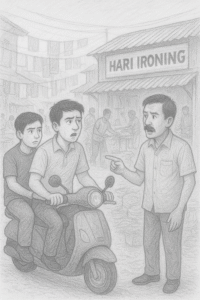
These unremitting cycles continued blissfully till, after some kind of a longish holiday, I placed four out of my five sets of trousers and shirts outside the room. The clothes did disappear promptly but failed to reappear the next morning. Left with only one pair, for the next four days, I was wearing my only set with the intelligent use of two old sweaters for the hospital wards. Strangely, like with all ancestral traditions where the origin of any practice remains dim and obscure, nobody in the hostel seemed to have a clue about the name, looks, workplace, or residence of the dear Dhobi (washing and ironing person).
However, I got a lead that he stayed in one of the “Dhobighat” areas near the hospital, catering only to washing and ironing. So, on the fifth desperate day, I scoured the area extensively, enquiring from shop to shop who might be the person in charge of our hostel’s fourth floor. Finally, we tracked the shop, which, not surprisingly, was shut firmly. Apparently, the owner was sick and had to be hospitalised. My colleague, who drove me around and made the enquiries, got sick of this adventure. He (bless his soul) took me to the nearest clothes shop to get seven pairs of trousers and shirts stitched (no readymade stuff those days). He paid from his pocket and told me to pay him as per my leisure. I had to divert money intended for books and movies for a few months to pay in installments. The ironing man finally returned my clothes after about three months.
I am grateful to have more clothes today, allowing me to make choices based on the occasion. However, an epiphany struck me when I realised the immense value of white shirts. I love white shirts for many reasons: a) It is a mix of all colours, as I learnt in physics; b) it reflects light better, according to Newtonian physics, which helps me navigate the Indian sun; c) aesthetically, it is still considered “class” by most designers across various fields, from clothing to interiors; d) it is suitable for all kinds of occasions; and e) very importantly, nobody knows how rich or poor I am since they mostly see me in white shirts, leaving everyone confused about my actual status. Therefore, I continuously and incessantly purchase white shirts.
It is also great when you can blindly pick up one, like choosing an answer in a multiple-choice question where all answers are right. Additionally, it pairs well with any trousers, including the pink, yellow, and red ones that have sneakily found their way into the wardrobe as loving gifts. I can also go into the first store and pick up the first white shirt that crosses my path. Contrast this scenario with my daughter, whom I once accompanied to a shop. She went through a hundred dresses, selected one, kept it aside, said she would come back and walked out of the shop. I was too scared to look at the salesperson even as his laser eyes burnt a severe hole in my head. My daughter explained to me that it is a rule that ladies never buy from the first shop they enter. Wow!
Of course, my dear wife hates the whites because they have an incredible ability to attract the worst stains emanating from food items, oils, blood, pus, iodinated solutions, and little children who show their displeasure by throwing up their excretory products. Surf Excel and other washing powders stay a safe distance from my house for their advertising campaigns. At my house, we firmly reject any claims that stains can be considered good. Those white clothes with permanent stains are sent for mopping floors or donated to charity. But whites have the advantage that I have an unspecified and unknown number in my wardrobe to fall back upon.

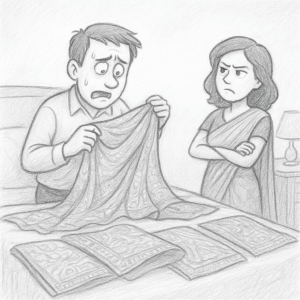
Ladies are different with regard to clothes, as I have discovered after a lifetime of study involving the three greatest women of my life: my late dear mother, wife, and daughter. Despite their wardrobe extending to all rooms of the house, including the kitchen and the bathrooms, they always seem to run out of clothes for wearing to a function. This is surprising because in every sundry place we visit in India, there seems to be an area famous for clothes suitable only for bulk buying. Thus, the entire country is represented in the wardrobe of my wife, from Banaras to Kanchi to Sialguchi to Patan Patola. And yet, the greatest terror for a husband or a father unveils when four dresses are dropped on the bed and he has to choose one for the upcoming function.
For newlywed grooms, do not be flattered; it is a trap. Your choice will never be accepted, and each selection will be dismissed until the fifth dress emerges from somewhere. The reasons? “I wore that for my… (nephew’s birthday party/cousin’s reception/neighbour’s son’s wedding/school annual function/daughter’s prize ceremony) … (1/2/3/5/6) years ago,” or “it clashes with the necklace/hairstyle/nail color/spectacles/shoes.” Nevertheless, you are still expected to make a choice, only to face brutal rejection.
I strongly suspect that event managers record every lady on video and then share it with all the women involved. These ladies, regardless of their age or profession, would likely analyse each video meticulously, aiming to memorise the outfits worn by everyone present. In summary, women typically choose a distinct, exclusive dress for each occasion, whereas men tend to wear a single, preferred outfit for all events.
Men are simple. Like it? Use it. A simple motto. If they like a dress, they will wear it until it is torn by repeated washings or shredded to pieces by the angry wife or daughter. A red T-shirt that was a constant companion for every formal, casual, and semi-casual event since the last decade has suddenly disappeared, and I strongly suspect my daughter has burnt it. A long time ago, my mother threw away two of my most favourite nylon shorts—one red and another black—in a deep old well filled with snakes. I thought they would never part with me for the rest of my life.
Anyway, such are the troubles with clothes for men. The question that arises, following the age-old chicken and egg dilemma, is whether it is clothes that make the man or the man who makes the clothes. After a lifetime of experience and contemplation, I believe I have arrived at an answer. This issue seems to be gender specific. For the average woman, it is indeed clothes that maketh the woman, while for the average man, the reverse is true. By average, I refer to those within three standard deviations of the norm, acknowledging that exceptions do exist. There are men who possess a genuine passion for clothing and women who are indifferent to such matters. However, as my dear English teacher used to remind me, exceptions only serve to reinforce the rule.