

Breaking the Scalpel Ceiling: Dr. Pooja Gupta on Leading in Surgery, Redefining Strength, and Standing Tall in the OR

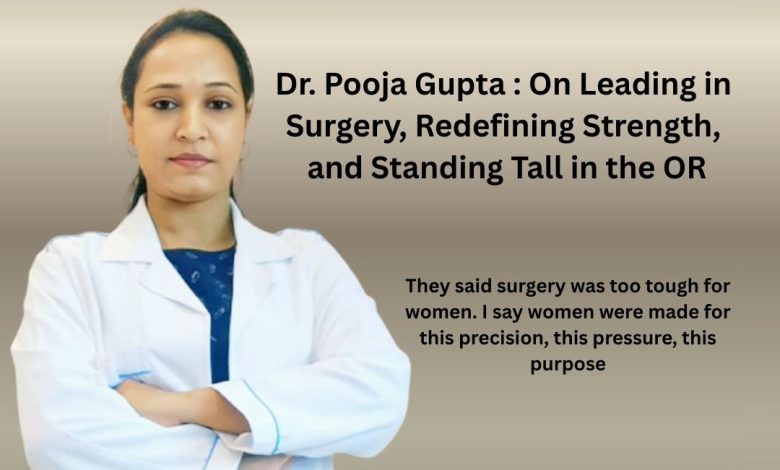
“They said surgery was too tough for women. I say women were made for this precision, this pressure, this purpose.”
In this edition of Her Shift, we spotlight Dr. Pooja Gupta, Head of Plastic Surgery at the Asian Heart Institute, Mumbai. At just 33, she represents not just excellence in the operating room but resistance, resilience, and reinvention in a field still dominated by male voices.
Dr. Gupta’s story is a tribute to every woman who’s had to raise her voice just to be heard, and every surgeon who has ever been mistaken for a nurse.
Meet Dr. Pooja Gupta
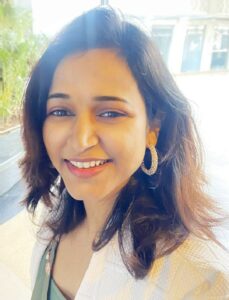
Dr. Pooja Gupta, a Plastic Surgeon with cutting-edge expertise in both reconstructive and aesthetic procedures.
Currently leading the Department of Plastic Surgery, as HOD and Consultant at Asian Heart Institute, Bandra, Mumbai.
Education & Training
Dr. Pooja Gupta’s academic journey reflects her passion and dedication. She stood first in 10th and 12th board exams and school and was an all rounder. She never attended or took any tuition or coaching classes for studies.
She earned her MBBS with distinction from Dr. V.M. Govt Medical College, Solapur, and completed her internship at Grant Medical College and J.J. Hospital, Mumbai. She pursued her Plastic Surgery residency, a 6 year of exhaustive training, at one of the top most post graduate Institutes, Sir Gangaram Hospital, Delhi, where she got trained under leading experts in the field, mastering complex reconstructive and aesthetic procedures.
With nearly two years of advanced cosmetic surgery experience at Mumbai’s prestigious Lilavati Hospital, and Jaslok Hospital, she has earned a stellar reputation among Indian, NRI, and international patients. Her commitment to innovation and patient-centric care makes her a leading name in modern plastic surgery.
Her Shift: An interview with Dr Pooja Gupta
🔹 Q1: What first drew you to surgery, especially plastic surgery?
Dr. Pooja Gupta:
Even as a child, I was drawn to the complexity of the human body. Biology was my favourite subject, and I was always fascinated by the bones and muscles of the human body.
But it was a video on hand reconstruction that made me fall in love with plastic surgery. Watching fingers being reattached and function being restored felt like witnessing a miracle. I didn’t just want to heal, I wanted to give people back a part of themselves.
🔹 Q2: What kind of resistance did you face as a young woman in surgical training?
A lot. From being mistaken for support staff to being overlooked during rounds. Being a female with a slender body, I was often not given the opportunity to assist in surgeries, and male colleagues were openly preferred. People questioned if I had the physical strength or “toughness” for surgery. It wasn’t easy walking into male-dominated departments where you’re expected to either harden up or stay silent. I chose neither. I stayed soft, but I showed up with unshakable skill.
🔹 Q3: What helped you overcome those biases and continue?
Consistency. I showed up first. I left last. I practiced relentlessly. I let my work speak before I did. I didn’t take up space with volume; I took it up with precision. Eventually, even the most skeptical colleagues couldn’t ignore that I belonged there.
🔹 Q4: As the Head of Department now, what kind of culture do you strive to build?
One that makes room for honesty, humanity, and growth. I don’t believe you have to mimic patriarchal leadership to lead well. I want juniors, especially women, to know they can lead as themselves. Not louder, not harder, just more aligned with who they really are. Most of the males in the surgical field show authority by yelling and shouting, which does no good. Female surgeons show more compassion, empathy, and work with calmness and precision, which keeps everyone positive.
🔹 Q5: What are some challenges uniquely faced by women surgeons that often go unspoken?
We don’t talk enough about menstruation during 8-hour surgeries, or operating while nauseous during pregnancy. There’s still no systemic empathy for the physical and emotional load we carry. We work through pain, fatigue, societal expectations, and still smile in discharge summaries and department meetings. It’s a different kind of endurance. And also, during the phase of pregnancy and post-delivery, the woman’s body and mind undergo a lot of changes. Still, most private hospitals lag in providing adequate support to us in such times.
🔹 Q6: What does success look like for you today?
Success is showing up without needing to shrink. It’s not just about leading a department, but creating space for others to rise. I want to normalize women being in charge, not as the exception, but the rule, and not to ever underestimate them in comparison to men, in the surgical field.
🔹 Q7: What’s your bigger vision for women in healthcare?
I dream of an all-women hospital, every role, every floor, run by women. Not to exclude anyone, but to prove and show that women can manage the entire system: precisely, passionately, and powerfully. We don’t need to borrow authority. We’ve always had it.
🔹 Q8: Has societal pressure around marriage or home life shaped your journey?
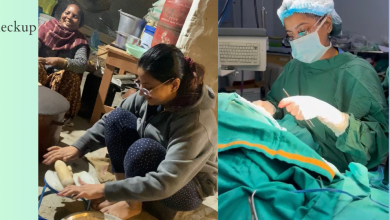
Yes. I’ve been measured more by how well I roll rotis than by how well I perform reconstructive surgery by my relatives and other people. People don’t realize the double burden of excelling at work while being judged at home for not conforming enough. You’re either “too ambitious” or “too emotional,” it’s always something. But I am fortunate enough to have the support and understanding of my parents in all my accomplishments and ambitions.
🔹 Q9: What would you say to a young woman afraid to enter the surgical fields?
Your fear is valid but not final. Let them call you soft. Let them underestimate you. And then prove them wrong with grace, with grit, and with quiet confidence and active leadership. We need more women with scalpels and voices.
🔹 Q10: And finally, has a book ever shaped how you view life?
Yes. The Kite Runner by Khaled Hosseini. I read it as a teenager, and it taught me the beauty of loyalty, compassion, and true friendship. It reminded me that the relationships we nurture, especially in tough times, are often our greatest strength. That has stayed with me, both inside and outside the OR.
✨ Her Shift is more than a column—it’s a stage.
It’s where the quiet, the fierce, the relentless voices of women in healthcare rise.
Dr. Pooja Gupta’s shift reminds us that leadership doesn’t always roar. Sometimes, it’s steady hands, a sharp mind, and a full heart in a scrub cap.
Know a woman in healthcare whose story should be told?
Nominate her here → https://forms.gle/XmEQ13gMphqvx1r76