

“Doctor, what if we deferred Dr Tripathi Sir’s appointment to later, at noon? After all other patients are done?”
The receptionist accosts me as soon as I try to sneak into my cabin in the morning. I want to remind her that there are only two patients on the appointment list, and Dr Tripathi is the first one. But I don’t.
Because I know what she means. She wants me to sit unoccupied, swatting flies (which are occasional; apparently, eye ailments are rare among flies). She wants me to file my IT returns in the resultant spare time. She wants me to finish my daughter’s school project. She will have me do anything other than consult Dr Tripathi first thing in the morning. Because she knows the consultation will stretch on till lunch break, with other patients being examined in short, impertinent breaks.
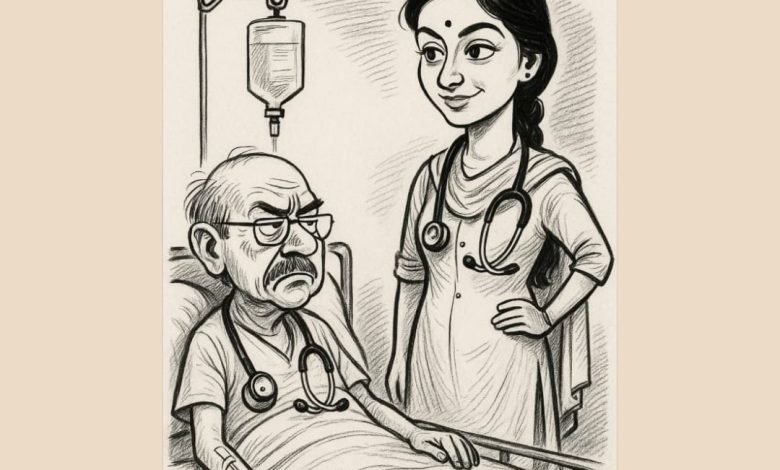
I refuse to do any such reshuffling. Dr Tripathi — a seasoned cardiac surgeon, veteran cardiac patient himself, and newly diagnosed glaucoma patient — deserves all my respect. He may ask questions. He may want to understand his diagnosis a little more. He may want to make an educated decision on what surgical approach we should try to control his glaucoma. All in good faith, I lecture my receptionist.
“What if he were not a doctor?” she asks, in resignation.
“It could solve a lot of our problems,” I concede, before adding, “He could still have all those questions.”
“What if you were not a doctor?” the senior nurse chimes in. “It would solve all of our problems.”
What actually happens after a gruelling two hours of consultation (I now remember Dr Tripathi had the reputation of being a tough examiner) is that he agrees to the proposed glaucoma surgery. But I know this is just the beginning of the ordeal.
Over the next month, he reschedules the surgery thrice. He calls me, and sometimes calls on me, to ask (in no particular order) if his condition of glaucoma could, in fact, be a misdiagnosed case of late-presenting Retinitis Pigmentosa; if his father could have been blind with glaucoma in his right eye before he died — and hence, forgot to include him (Dr Tripathi), who was standing to his right, in his will; if he could develop low eye pressure as a complication of the proposed surgery — and if there was already a dynamic balloon-like device that could measure his eye pressure in real time and auto-inflate to generate pressure each time it dipped. (There isn’t. This could, in fact, be an excellent research proposition.)
As I lay awake the night before Dr Tripathi’s third proposed date of surgery, I mull on how it is to have a doctor for a patient. And to be a patient myself.
Here are the broad categories I have characterized in the typical doctor-to-patient transformation behaviour. The patient could belong to more than one category. Here we go:
- The Inventor
Comes up with devices, tweaks lines, and wants things “innovated” at the bedside.
Remember Dr Tripathi’s balloon pressure generator?
- The Interrogator
“How many cases a year?” “Complication rates?” “Does the doc have a drinking problem?”
She does not, but she might develop one now.
- The Inspector
Checks IV cannula batch numbers, expiry dates, and sterile field protocol like a hawk.
Each time his follow-up is scheduled, the housekeeping staff cleans the ceiling fan in advance. Lost registers get found. And a few suspicious ones get lost too.
- The Serial Complainer
“The wall colour will trigger food cravings.” “The food is clinically depressing.” “The nurse is too cheerful.”
Sir, will feeding the cheerful nurse depressing hospital food solve the problem?
- The Know-All-err
Casually cites American Association of whatever-speciality-you-happen-to-be-discussing guidelines, sometimes in the middle of the surgery.
- The Hyper-Hypochondriac
“Could this be glaucoma secondary to reactivation of a dormant extrapulmonary Tuberculosis focus?”
Not that he has ever suffered from tuberculosis.
- The Problem Solver
Mediates between edgy doctors and hostile patients, calms both. He/She generally has a smattering of silver hair and a radiant chipped-tooth smile. They also mime answers to junior doctors being grilled on patient history during clinical rounds.
- The Memory Keeper
Recalls OT staff from 1972, names every nurse and their kids. Lapses into nostalgia thrice a day and misses his last dose of antibiotics. Launches into teary monologues on the meaning of life and medicine. Ironically, these doctors in their youth have often been tough taskmasters, known to bring their fellow junior doctors to tears over an error in prescribing a different quality of Q-tip earbuds.
- The Thespian
Dramatic speeches, gathers family by the bedside, declares guilt and farewell in consecutive sentences. Often, these are the ones admitted for relatively mild conditions and will get to re-perform the same dialogue a decade later.
They also compulsively share OT-table jokes and grandkids’ pics mid-catheterization, often laughing themselves into minor injuries.
10. The Googler General
Arrives with PubMed printouts, has a self-made differential diagnosis list, times handwashing steps, notes every deviation, mildly disapproves. Pretends to sleep while absorbing everything happening at the nurses’ station. Knows they missed giving them the last dose of antacid, and that gives them heartburn.
11. The Prognosis Prophet
“By Day 3 I should be ambulating… Day 5 CRP will normalise.” Writes their own discharge summary mentally. The attending physician in this case often begs to be discharged (from duty), against medical advice.
12. The Wellness Warrior
Yoga mat, diffuser, herbal teas, pranayama between IV infusions. Often recommends breathing exercises to the ‘sister’ on night duty to keep her circadian rhythm unperturbed.
13. The Ego-Hardliner
Can’t tolerate a junior telling them what to do. “I was doing this before you were born.” Often, they turn out to be the attending obstetrician when the junior was born.
14. The Compulsive Memer
Shares grandkids’ pics, WhatsApp forwards from family groups, and OT-table jokes compulsively. Is liable to laugh while being catheterized, and thus, is prone to innocent injury.
15. The Telemedicine Multitasker
Runs OPD from the ward bed; “Patients are depending on me.” May also run a vlog and have a giant fan following. The hospital PR team is constantly hounding us for updates on when they are scheduled for their next follow-up.
And then, there are experiences, and ‘doctor-patients’ who do not fit anywhere on this list. They, however, live on in our minds and hearts. The ones who discover their worth beyond the diagnoses they made and patients they treated in this very hospital.
Hobbies, spirituality, forgotten love? Reunion of friends from undergraduate days? Meeting children whose PTA meetings they missed; and who have missed their kids’ cricket match to meet their parent perhaps one last time.
The ones who conquered cancer, twisting, excising, melting it with heavy-duty chemo-cocktails for scores of patients, who now know they are succumbing to malignancy. The neurosurgeon who could operate for fourteen hours at a stretch routinely, and now can’t spell Alzheimer’s on a good, lucid day.
I have deliberately avoided writing about one specific, expanding category of doctor-patients — the ones lying in ICUs either recovering, or succumbing, to episodes of mob violence while on duty. The ones staring at their future with a sense of impending doom: their injuries, physical and mental, have left them incapable of continuing to practice as doctors. But we shall not talk about that, because the best place for such issues is the blind spot in society’s otherwise progressive viewpoint.
Turns out, when a fellow doctor needs treatment, both he and his treating physician need to be patient.