

Vehicles have played a significant role in my life, much like they have for many others. Ages ago, my father’s company, a Public Sector Undertaking (PSU), offered its employees a perk to purchase a car with the added attraction of a monthly fuel allowance. The latter incentive was sufficient for all the officers to acquire second-hand cars – the most feasible option given the package. As a result, in a predominantly middle-class area of Ahmedabad, the four blocks of government quarters, each consisting of eight flats, suddenly had thirty-two cars parked outside in the open ground. We unexpectedly became a “posh” locality within the larger apartment complex, attracting envy from many onlookers.
Problematically, many individuals did not know how to drive, which for some meant merely starting the car for five minutes in the morning, revving the engine, moving the steering wheel with great delight, and then turning it off. The incentive was the monthly fuel allowance. Many of the cars were close to being scrapped and had a propensity for frequent breakdowns. Our car was one such unfortunate acquisition for my father.
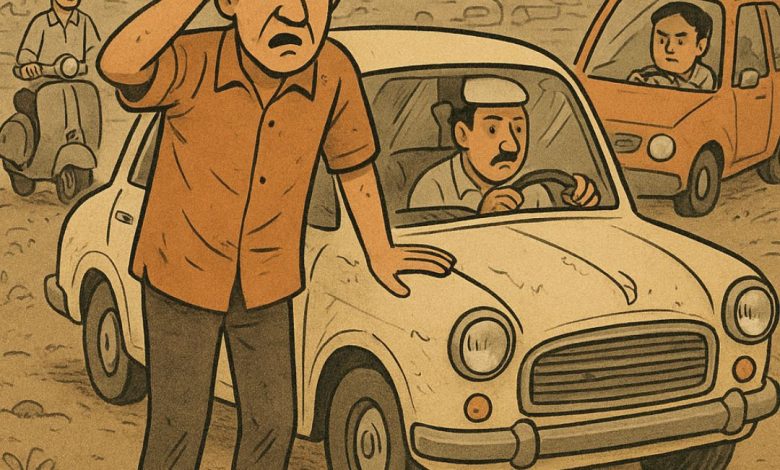
The so-called variety consisted solely of colours, as they were all either Fiats or Ambassadors. We were the less-than-proud owners of the latter. Owning this car led to numerous acute embarrassments. It accompanied us and our luggage to various cities across the country when we were transferred. However, it spent more time under covers than on the roads due to constant repairs. When I got married in Mumbai, it took my wife nearly a year to notice that we had a car parked in a remote corner of the parking lot. Such were our family secrets. Ultimately, we exchanged the car for a T-shirt.
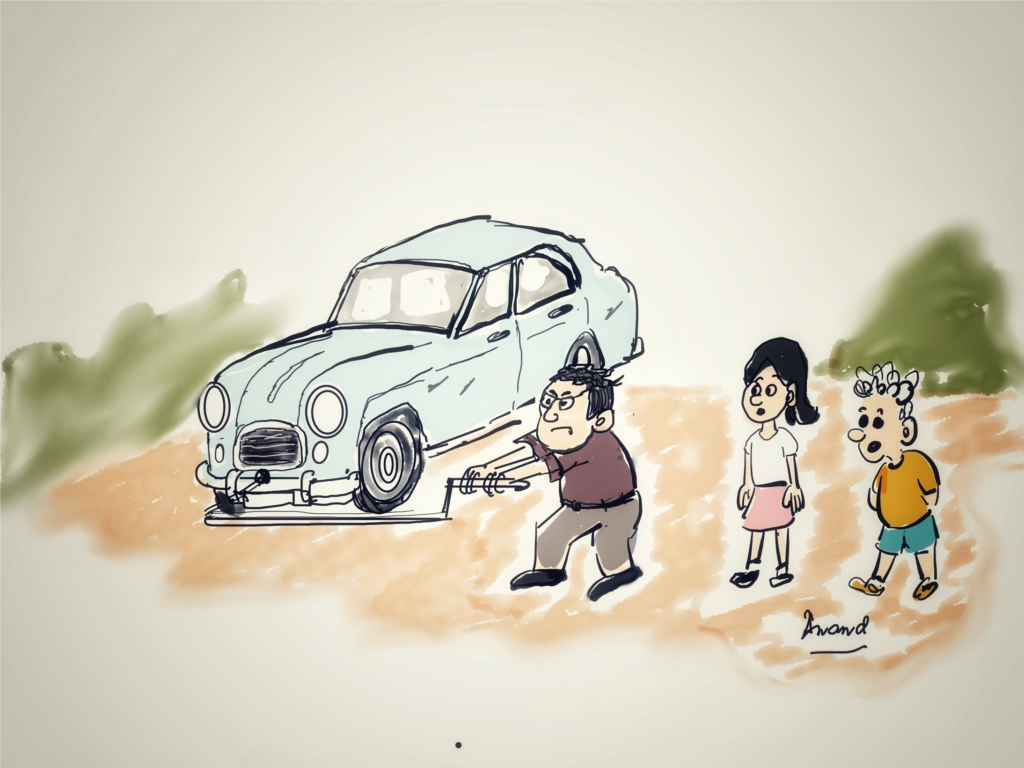
I remember our second-hand Ambassador vividly since I was more outside the car than inside. We were frequently coming out of the car to either push it or use a peculiar crank, which helped in starting it. My father once gave the wheels to me for a brief period in a fit of generosity. I crashed it against a low-level brick wall that materialised out of nowhere. The crash left me permanently scarred and instilled a deep-seated and psychological aversion to driving. My father ultimately spent more money on the repairs than the cost of the car itself. The guilt shattered me.
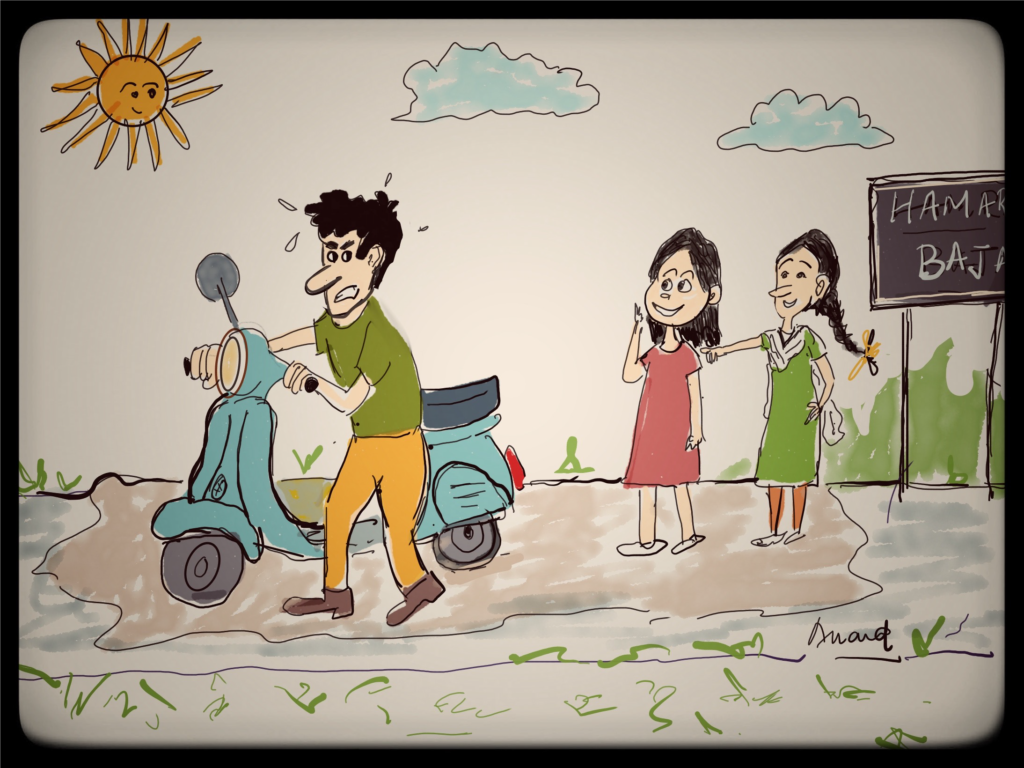
Our antique scooter did not prove to be of much help. I asked my father if I could use the scooter in my second year of medical school, as my bicycle was becoming rather slow. I also wanted to impress the girls. However, my plan backfired spectacularly, as the scooter would frequently break down, particularly when I was riding past them. Pushing the scooter in front of giggling girls is a humiliating experience that no young man in college should have to endure. Finally, I returned to using the bicycle, which I could manage better, dealing with punctures and slipping chains more effectively, without anyone noticing.
During my internship, I was eventually gifted a motorised two-wheeler. I had hoped for a muscular bike, but my father presented me with a scrawny, emasculated version – a moped. This peculiar vehicle functioned as a bicycle when the engine failed, or the fuel tank ran dry. I found myself cycling the Luna far more often than actually riding it. The most romantic thing my moped ever did was when my junior used to go around his sweetheart’s house at 2 am in the mornings with me on the back seat. The junior, who is now a prominent cardiac surgeon, would likely deny this vociferously. Women would perhaps prefer to choke and die rather than be seen riding as a passenger on this most unromantic vehicle in the world.
Anyway, fast forward many years. My aversion to driving remains even today. This was exacerbated by the fact that when I began my practice, peculiarly, I had a driver before I owned a vehicle. My dear brother-in-law trusted me with his car while he was abroad. A young, unemployed person recognised potential in a man who lacked driving skills but owned a vehicle. He became my driver. I can thankfully afford to buy a new car today, but a driver stays intact.
While I consider myself reasonably competent to take the vehicle out, my driver is an integral part of my life today. When friends, particularly those from abroad, assume I am super wealthy to afford a driver, they remain unaware of the extensive history. Poor souls are not aware that “wealthy paediatric surgeons” is taught as a classic oxymoron by English teachers in their poetry classes (just as “wonderful paediatric surgeons” is a classic tautology). With a hopeless dependency on my driver, I often feel envious of those passionate individuals who drive across the world, exploring continents, countries, hills, and long roads. There are also extremely passionate drivers who enjoy navigating our cities. I dream of long drives with family, but my driver seems to insinuate himself in these dreams. This undoubtedly troubles my wife and diminishes the romance of long family drives.
My driver is highly aware of my limitations and his significance in my life. Consequently, I must grin and bear his erratic demands for salary increases and unpredictable time off. He possesses an invisible power over me. My car has a peculiar tendency to acquire scratches and dents when I drive on Sundays, after 7 pm on all other days, as well as on numerous occasions throughout the year when the driver is absent. He appears to belong to an unusually large family, and the frequency of births, deaths, weddings, anniversaries, birthdays, and hospitalisations among his relatives seems way too high – far beyond three standard deviations.
I pray to God fervently that he does not notice my mishaps but sure enough, the next day, he is polishing hard with a smooth cloth on that exact spot and looking pointedly at me. I shuffle my feet and sheepishly explain how a drunk biker, a careless dog, or a poorly parked vehicle was the cause of that scratch or the dent. And his face cracks into just a hint of a special diabolical smile which tempts me to break his head open.
I know it is crazy, but I almost wish that he does something which would give my vehicle a little scratch or a dent. Hang the expenses. Once he did, overlooking an oversized speed braker placed randomly in the middle of a colony road with no marking. The underside of the car had to have some repairs. But the look on his face when the bill came from the thug repairer made it all worth it. The same kind of pleasure I get when my wife breaks or drops something in the house. I cannot be the sole representative for imperfection. Anyway, such are my woes with vehicles, and I wish for the great olden days when walking was a necessity and bicycle, a luxury. Now, the motorised two and four wheelers are a necessity and walking, almost a luxury. Damn the progress.
ILLUSTRATIONS: DR ANAND NAREGAL