



It is midnight in Bangalore, Dr. Priya Sharma sits in her car outside her hospital, scrolling through three job offers on her phone. One promises the independence of solo practice in Pune, another offers partnership in a multi-specialty clinic in Chennai, and the third guarantees corporate security with Fortis Healthcare. Like thousands of Indian physicians each year, she faces a career-defining choice that will reshape her entire relationship with medicine.
Solo Practice: The Traditional Indian Doctor’s Dream
In the narrow lanes of Old Delhi, Dr. Rajesh Gupta runs his clinic the way his father did—with deep patient relationships and complete autonomy. His patients call him “Doctor sahib” with genuine respect, and he knows three generations of families by name.
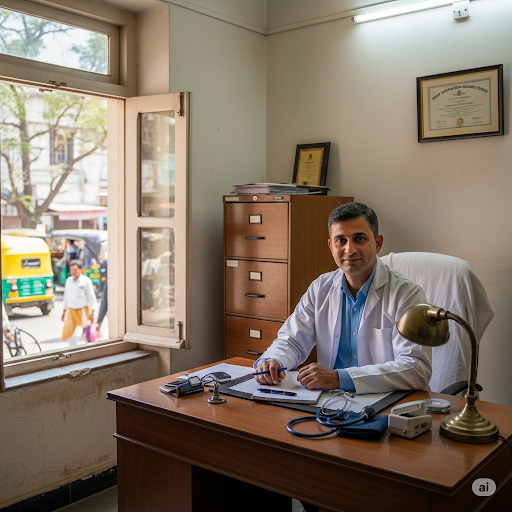
Solo practice remains the romantic ideal for many Indian doctors. Here, you control everything: consultation fees, treatment protocols, even clinic timings. When Mrs. Mehta needs extra time to discuss her diabetes management, there’s no administrator checking productivity metrics.
But modern realities bite hard. Dr. Kavitha Nair in Kochi explains: “I spend more time fighting insurance companies than treating patients. The paperwork for Ayushman Bharat alone requires a full-time assistant.” Yet successful solo practitioners like Dr. Arun Krishnan in Coimbatore report deep satisfaction. “My patients trust me completely. When I recommend surgery, they don’t seek second opinions—they know I have their best interests at heart.”
Group Practice: The Collaborative Middle Path

At Medanta Group Practice in Gurgaon, five specialists share resources, knowledge, and call duties. Dr. Reddy, a pediatrician, describes the transformation: “Instead of handling everything alone, I focus on what I do best while my partners manage their specialties. Our combined reputation brings more referrals than any of us could generate individually.”
Group practices offer compelling advantages in India’s competitive healthcare landscape. Shared infrastructure reduces individual overhead costs significantly. When Dr. Vikram Singh in Jaipur wanted advanced diagnostic equipment, his six-doctor group could afford what would have bankrupted him individually. Rural group practices can pool resources to serve larger geographic areas, while urban groups leverage specialization to compete with corporate hospitals.
However, partnership disputes remain common. Dr. Meera Joshi in Pune learned this painfully: “Revenue sharing discussions became personal attacks. We eventually dissolved the partnership after eight successful years because we couldn’t agree on expansion plans.”
Corporate Employment: Security in Scale

That gleaming hospital building in Bangalore represents modern Indian healthcare—technology-enabled, protocol-driven, and professionally managed. For Dr. Arjun Patel, transitioning from a struggling solo practice to corporate employment felt like stepping into the future.
Corporate healthcare employment has exploded across India. Chains like Max Healthcare, Fortis, and Apollo offer compelling packages: guaranteed salaries, comprehensive benefits, modern equipment, and most appealingly for many, work-life balance.
Dr. Divya Iyer, an emergency physician at Delhi, appreciates the structured environment: “I clock in, treat patients using world-class resources, and clock out. No billing headaches, no staff management, no equipment maintenance—just pure medicine.”
The financial security attracts younger doctors burdened with education loans. Starting salaries in corporate hospitals often exceed what struggling solo practitioners earn after years of building their practice.
Yet some doctors report feeling like healthcare factory workers. Dr. Rohit Malhotra at a Chennai corporate hospital confides: “We’re measured on patient throughput, revenue per hour, and satisfaction scores. Sometimes I feel like I’m practicing medicine through Excel spreadsheets rather than clinical judgment.”
The Indian Healthcare Reality Check
India’s healthcare landscape presents unique challenges regardless of practice model. The vast economic disparity means doctors must navigate treating both paying customers and economically disadvantaged patients. Government schemes like Ayushman Bharat promise coverage but often involve bureaucratic nightmares and delayed payments.
Medical education costs have skyrocketed—a private medical college seat can cost ₹1.5 crores, pushing graduates toward higher-income practice models. Yet rural India desperately needs healthcare, creating moral dilemmas for young doctors choosing between financial necessity and social responsibility.
Technology’s Impact on Indian Medicine
Digital India initiatives are transforming medical practice. Telemedicine platforms like Practo allow solo practitioners to reach patients across the country. Dr. Suresh Kumar in Mysore now consults with patients in remote villages through video calls.
Corporate hospitals leverage AI for diagnostics and electronic health records for efficiency. However, smaller practices often struggle with technology adoption costs and training requirements.
Financial Realities Across Models
Solo Practice: Highly variable income depending on location and specialty. Delhi dermatologists might earn ₹2-5 lakhs monthly, while rural general practitioners struggle to reach ₹50,000. Overhead costs and irregular patient flow create financial stress.
Group Practice: More predictable income with shared risks. Established groups in metros typically provide ₹1.5-3 lakhs monthly per doctor, with profit-sharing bonuses based on group performance.
Corporate Employment: Stable salaries ranging from ₹8-15 lakhs annually for freshers to ₹25-40 lakhs for experienced specialists. Benefits include medical insurance, provident fund, and professional development opportunities.
Making Your Choice: The Indian Context
Your decision should align with personal values, financial needs, and career stage:
Choose Solo Practice if you value complete autonomy, have strong business acumen, can handle financial uncertainty, and want deep patient relationships. Works best for established doctors with loyal patient bases.
Choose Group Practice if you enjoy collaboration, want to share business risks, value peer consultation, and seek work-life balance. Ideal for specialists who benefit from cross-referrals.
Choose Corporate Employment if you prioritize financial security, prefer structured environments, want access to advanced technology, and value predictable schedules. Best for young doctors or those seeking stability.
The Path Forward
India’s healthcare system is evolving rapidly. Public-private partnerships are expanding, medical tourism is growing, and preventive care is gaining importance. Successful doctors will adapt their practice models while maintaining the healing touch that defines excellent medicine.
Whether in a small clinic in Varanasi, a group practice in Hyderabad, or a corporate hospital in Mumbai, the fundamental challenge remains constant: providing compassionate, competent care while building a sustainable career.
The choice ultimately depends on answering one question: What kind of doctor do you want to be, and which environment will help you become that person while serving India’s diverse healthcare needs?
Choose wisely—your patients, your family, and your own fulfillment depend on it.