

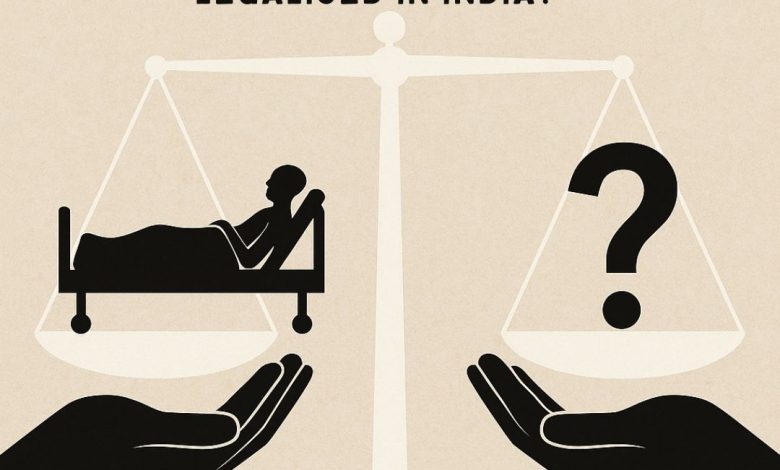
The topic of euthanasia has always been contentious and emotionally charged. Debates around euthanasia have been raging for decades across the world, with countries having diametrically opposite laws on it. In India however, the issue of euthanasia hasn’t quite captured public imagination the way it has in the west. There is a growing clamour for legalising it in India the way it has been in several other countries. But does India really need legislation on euthanasia? Why is the subject so hotly debated? What can be considered permissible in the name of euthanasia? Let’s take a closer look at some of these questions and see if we can actually get any good answer to them.
Euthanasia is defined as the practice of intentionally ending a life in order to relieve suffering. It is derived from the Greek and literally means ‘good death’. But euthanasia is far more complicated and nuanced than is conveyed in this simple definition. It has wide reaching legal, ethical and moral implications. On one side is the anguish and desperation and pain of patients and their loved ones, and on the other is the respect for the sanctity of life and the decree of the law. Caught in the crosshairs are doctors, who are often find themselves in moral dilemmas and are forced to choose between empathy and rectitude.
CURRENT LEGAL STATUS OF EUTHANASIA IN INDIA
India did not have laws on euthanasia till quite recently, when the Supreme Court passed guidelines in 2018. Till then, judgments were delivered on a case-by-case basis. Indian law distinguishes between active and passive euthanasia. Active euthanasia, which involves taking deliberate actions to end a patient’s life is illegal. Passive euthanasia, which involves the withdrawal of life-sustaining medical treatment, is more complex. As of 2018, only passive euthanasia is legal in India. The court ruled that the right to die with dignity is a fundamental right, intrinsic to the right to live, which grants an individual the right to choose how they die, including by refusing treatment. This involves an individual making an advance directive, in lieu of which family members can approach the court for permission to withdraw life support.
THE REACTION TO THE SUPREME COURT GUIDELINES
Many cheered when the Supreme Court granted this legal latitude. Many more were disappointed and argued that it isn’t enough, claiming that the guidelines are too narrow and restrictive. Not everybody is in a position to make advance directives. In the absence of such a document, only the court can authorise euthanasia, taking this power away from doctors who have a better understanding of the seriousness of a patient’s clinical condition and are in a position to take timely action. Ultimately, the doctor and the patient and/or their relatives must be able to come to an agreement regarding termination of life, without the intervention of the court.
There are others who want the guidelines to be even more permissive. They don’t agree with the line that the Supreme Court has drawn, that life cannot be actively taken, only passively allowed to end.
WHEN REMAINING PASSIVE ISN’T ENOUGH
Take the case of Harish Rana. Harish lived an ordinary life. He was pursuing a BTech degree, living in a hostel, doing things that any youngster his age might. All that changed one fateful day in 2013, when he fell off his 4th floor balcony, sustaining severe head and spinal injuries. His parents ran from pillar to post, getting him the best treatment they could afford. Even their best efforts however, could not save him from being completely bed ridden.
Today, Harish lies in a vegetative state, unable to move, hear or respond to his surroundings. He is fed by an external food pipe and has no control over his excretory functions. His elderly parents are physically, mentally and financially exhausted from having to look after him. They worry about who will look after him after they’re gone. In their desperation, they approached court with a plea that was equally heart breaking and appalling- that they be allowed to end Harish’s life. The court turned down their request on the grounds that Harish’s body was performing its vital functions and he was not dependent on any lifesaving treatment or devices and therefore could not be permitted to die by active means.
Harish, and thousands of others like him would require active euthanasia to be relieved of their suffering. Many debilitated individuals are in fact, not on life support. They live dependent on caretakers or nurses, with little or no control over their bodily functions, kept functioning by tubes and pipes sticking out of various orifices, often having minimal awareness of the world around them, passing out their existence as objects to be tended to, rather than humans capable of participating in their own care.
The need for compassion in extreme circumstances is at the heart of pro-euthanasia arguments. Many would choose an easy way out over a living death. Even the Supreme Court has recognised the right to die with dignity as a fundamental right, but severely curtailed the means to achieve such a death, resulting in the prolongation of the suffering of both the patient and their caregivers. Dying should be a private matter, beyond the purview of the court or state, and when a sick individual decides it’s time to move on, they, along with their loved ones should have the right to do it on their terms, instead of waiting endlessly for a death that may be long in coming. Aquinas’ doctrine of double effect- which states that if doing something morally good has a bad side effect, it’s ethically okay to do it, provided the bad side-effect wasn’t intended- applies here. A doctor may administer pain relieving medicines which may shorten the patient’s life, as long as the primary intention is to relieve pain, not to cause death. To quote Shakespeare, sometimes we must be cruel, only to be kind.
THE SLIPPERY SLOPE ARGUMENT
Not all requests for euthanasia may be altruistic. There is every chance of relatives or caregivers requesting euthanasia for a patient for nefarious purposes, especially when the patient is not capable of giving consent. In such scenarios, it is imperative to preserve the sanctity of life and not be hasty in terminating it. Besides, with advances in palliative care and pain management, euthanasia may not be the only viable option available to allay suffering. To be too liberal or cursory while prescribing euthanasia is akin to standing on slippery slope. It erodes the regard for life while making death seem like a legitimate option even in situations where it might not be.
In countries like The Netherlands or Belgium which have permissive laws, euthanasia is allowed for non-terminal illnesses (including psychiatric disorders) as well, albeit under strict monitoring. Critics are concerned about the rising number of people opting for euthanasia citing unbearable personal distress or mental anguish in the absence of any physical illness, and being granted permission for it. Rather than glorify it as a triumph of personal autonomy, it should make us reflect on the failure of social support systems. Instead of offering death as a legitimate option in the face of hardship, there should be an effort to fix systems that are broken, and help individuals integrate better into a society that they feel disconnected from.
THE WAY FORWARD
Given the compelling arguments for and against euthanasia, it’s important to find a middle ground that satisfies both sides. In a resource strapped country like India, we must aim to regulate euthanasia in a way that is both ethical and compassionate. Formal legislation on euthanasia should be passed so that there is clarity regarding its dos and don’ts. Doctors must be given more autonomy in crunch situations, without fear of prosecution. The ambit of passive euthanasia must be reviewed so there is some leeway for individuals who are not on life support. Pleas for active euthanasia may be taken up for consideration on a case-by-case basis. While the means don’t justify the end, the ‘end’ must not become an excuse to stifle the means either. Till we find a way to achieve an acceptable balance, the battle between the detractors and proponents of euthanasia will continue.
May the most righteous side win, always.