

They say monsters aren’t born; they are made. Forged in the fire of long hours, tempered by the weight of impossible expectations, and sharpened by the cruel hands of those who came before. He was not always this way. Once, he was human.
The hospital breathed around Dr. Saaransh Verma. The hum of machines, the rhythmic beeping, the distant murmur of voices. Somewhere, a monitor screamed, another body failing to keep up with the demands of existence. He walked the corridors as if floating, detached from it all, a spectator among the living.
“You’re late,” snapped a voice—annoyed with a tinge of judgement. It was one of his co-workers, Dr. Vikram Nayyar, sucking up to a senior standing behind him. Names blurred together now; they felt like faceless figures in an endless chain of authority.
“Didn’t realize you were keeping track,” he replied, his voice like steel despite knowing that this would have consequences.
He had endured it for months—the passive-aggressive comments, the way Dr. Vikram always found a way to undermine him in front of others. It started small: a sharp remark about his technique, a pointed sigh whenever he asked a question that should have been ‘obvious.’ Then came the constant nitpicking, the public criticisms framed as ‘teaching moments.’ He had ignored it, gritted his teeth, focused on his work.
His work was almost perfect, if not the best. He knew it, and so did others. People praised him, trusted him with responsibilities beyond his years. Vikram though—Vikram was different. He wasn’t looking for mistakes; he was waiting for them. And tonight, after thirty hours without sleep, after watching a patient crash and burn despite everything, after dragging his aching body through yet another set of endless rounds, Saaransh slipped.
He had forgotten to collect a patient’s reports, buried beneath the weight of the last shift’s exhaustion. It was a minor oversight—easily correctable. But Vikram saw an opportunity.
By the time he returned to the ward, the damage was already done. The senior, Dr. Deshmukh had been informed. The reprimand was swift and public.
“You think you’re working hard, but hard work means nothing if you’re careless,” the senior said, voice cutting through the fog in his head. “This is basic responsibility. If you can’t even manage that, maybe you should rethink whether this is the right field for you.”
He clenched his jaw, angry at this unfair behaviour. He wanted to argue, to scream, to remind them of the sleepless nights, the hours of perfecting his craft, the relentless sacrifices. Not working enough? That was the accusation?
Vikram stood off to the side, arms crossed, that smug smirk tugging at his lips.
It happened in the hallway, with the junior doctors watching.
“Do you even think before you make these decisions?” Vikram’s voice sliced through the haze of exhaustion clouding his mind. “Or do you just rely on luck and hope no one notices?”
His hands curled into fists. “Not now, please.”
The co-worker scoffed. “Not now? Oh, I’m sorry, should I wait until you kill another patient before I say something?”
He turned, his vision tunnelling in on the man before him. The exhaustion, the years of swallowing his frustration, the relentless pressure—everything boiled over at once.
“You think I don’t notice?” His voice was sharp, raw. “That I don’t hear every damn word you mutter under your breath?”
Vikram barely flinched; his smirk infuriatingly intact. “Oh, so you do have a backbone. Good. Maybe use it next time before you make another mistake.”
Something dark clawed its way up his throat, but before he could spit out another word, the realization hit—he wasn’t alone.
“What do you think you’re doing?! You incompetent idiot!”, Dr. Nayyar raised his voice.
The interns were staring, wide eyed, caught between awe and fear. The nurses had stopped, their conversations hushed. The air was thick with something unspoken, something electric.
He had given them a show. A reckless decision. And that was the moment something inside him cracked.
He stood still, staring straight ahead, eyes fixed on the senior’s face but not really seeing. The words drifted into his ears, but his mind split apart in different directions.
I could quit right now. Just walk out and never look back. Let’s see what this pretentious bastard says then. Let’s see them scramble when there’s no one left to do the work.
His fingers twitched, his hands curling behind his back, nails digging into his palm. He squeezed them together, grounding himself, the pressure a small, invisible rebellion against the voice in his head.
“…Are you listening? You need to complete the work Dr. Vikram hands you over before 8 o’clock today” the senior’s voice snapped, yanking him from the abyss.
“Yes, I’ll do it.”
The response came without thought, Pavlovian, automatic. His body already moving before his mind could catch up, already breaking apart the task into smaller steps, already making room for more exhaustion.
“You should rest,” Vikram said, voice laced with mock concern. “Before you burn out completely.” The co-worker, irritated, handed Saaransh a list of tasks to be completed without further explaining before rolling his eyes and dashing off.
The adrenaline that had momentarily cut through his exhaustion began to fade, and what remained was an aching, gnawing feeling in his chest. The juniors still stood there, watching him, waiting for something—an explanation, a justification, anything.
He exhaled sharply, forcing his voice to steady. “Get back to work.”
Interns hesitated at first, then scurried away like startled birds.
Saaransh had been like the juniors once, wide-eyed and ambitious. He did not know when exactly it had changed—when he had changed. Maybe it was not a single moment, but a slow erosion, the way a river carves stone, unnoticed until the shape is unrecognizable.
He moved through his tasks, numb, almost like a robot and with efficiency of someone who had long since stopped questioning the weight on his shoulders. Blood sampling? Done. X-rays? Sorted. The queue of pending cases never seemed to shrink, yet he pressed on. He drained fluid from the abdomen of a seventy-year-old man with alcoholic liver cirrhosis. A trauma patient needed urgent reassessment, a post-op case required monitoring, and a confused elderly woman with undiagnosed delirium had pulled out her IVs again.
He still had to coordinate neurosurgery and psychiatric consultations, which meant wading through endless pages of notes and dealing with overworked specialists who barely spared him a glance. The pushback was routine now — “Why was this even referred?”—but after some back and forth and a few sharp remarks thrown his way, the requests were approved.
His body ached, his legs threatening to give out beneath him. He couldn’t remember the last time he had sat down for more than a minute. His limbs felt heavy, his head clouded with exhaustion, but there was no time to stop. Not yet.
Finally, after what felt like a lifetime, he finished his last task. Stretching his sore muscles, he dragged himself toward the doctors’ room, hoping for just a few moments of silence.
And then, the world tilted.
For a moment, he wasn’t in the hospital anymore. The air shifted, thick with something ancient, something alive. A whisper—not in his ears, but in his bones.
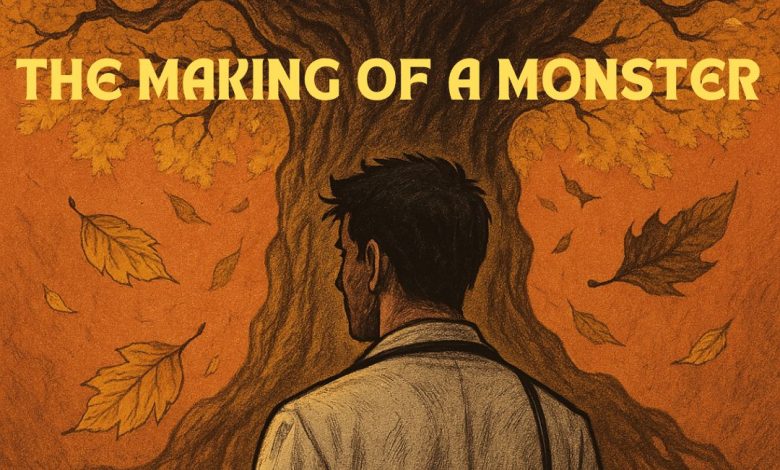
He stood before a tree, towering, ancient, almost eternal. There was no breeze, yet the leaves trembled. Some were golden, heavy with ripeness, while others blackened at the edges, rotting from within. Duality, eh? Something about that tree spoke to him as it felt just like him. Magnificent yet, rotting at the same time. Surviving.
And then the voices came.
“What have you become?”
“You can leave. You could leave.”
“But will you?”
A figure sat beneath the tree; an old woman draped in fabric that shimmered like the very air around her. She watched him with knowing eyes.
“You came far,” she said. Her voice was neither warm nor cold—just… there. “And now you stand here.”
“I don’t understand.”
She smiled, and something about it unsettled him. “You do.”
The wind picked up, though there was no source for it. Leaves swirled, golden and withered alike, caught in the same current, bound to the same fate.
“The ones before you stood here, too,” she continued. “They listened. They touched the bark, felt the weight of their choices.”
He looked at his hands. Scarred, trembling. Tired. “What is this place?”
She leaned back against the tree, her fingers brushing over the bark like an old friend. “A reflection” she smiled. “A crossroads. A reminder. Call it whatever you want”
He reached out, hesitating. The wood was solid beneath his palm, yet it pulsed—alive, breathing, aching. A flood of memories rushed through him. The weight of exhaustion, the moments of cruelty, the silence that followed when he stopped caring. The junior doctors, the patients, the faces he had turned from because it was easier to survive that way.
His breath shuddered. “I—”
“Do not ask me for answers,” she said, standing. “You already know them.”
He swallowed. “I thought about leaving.”
She smiled, but not unkindly. “Many do. Few actually quit.”
He reached out, hesitating. The wood was solid beneath his palm, yet it pulsed—alive, breathing, aching. And suddenly, he knew.
He had a choice.
But no matter how hard life got, no matter how deep the exhaustion ran, he had chosen this. He had chosen this. And nothing could take that away from him.
The leaves above trembled harder now. A choice. He had not been given many of those in his life, but here, now, in this place where reality and mind blurred together, he had one.
A sharp sound pulled him back—an intercom, an urgent call for a code blue. The hospital snapped into focus. He was standing in the corridor, a nurse staring at him, concern flickering across her face. How much time had passed? Had any time passed at all? To confirm, he took out his phone from his pocket, only to see a couple of golden leaves fall out.
“It wasn’t a dream?”, he muttered
“Doctor! Bed number 16 is desaturating!”
His body moved before his mind could catch up. He sprinted down the hall, pushing through the doors of the emergency ward. A patient lay there, breath shallow, slipping fast.
No hesitation. No doubt. Just action.
“Intubation tray—now.”
He heard himself bark orders, saw his hands move with practiced precision. The team worked as one, their movements honed by necessity. Within minutes, the patient stabilized. Alive.
A rush flooded through him—not just relief, but something fierce, something electric. He had saved a life. This was why he had chosen this path. Not for the hierarchy, not for the endless grind, but for this.
Somewhere, deep inside, the leaves on the tree shifted. Maybe, just maybe, the golden ones would outnumber the withered ones someday.
Later that day, a nurse approached him, “Doctor, there’s… someone asking for you.”
He inhaled, steadying himself. “Who?”
“A new intern.” She paused. “She said you might understand.”
He followed. The intern stood awkwardly, shifting her weight between her feet. “I just—I wanted to ask—” She exhaled. “How do you do it? How do you not let it get to you? You’ve always worked so hard, trying your best to save patients. Despite that, we saw you being belittled and yet you didn’t lose your cool! I thought you’d take some extreme step! Maybe something like, quit or punch him.”
He stared at her for a long moment. He had been asked this before. His usual answer was clipped, indifferent—You toughen up. You stop caring. You survive.
“Yeah, I thought I’d quit too.”, He thought to himself
But tonight, the whisper of leaves still lingered in his mind.
He sighed. “How do you not let it get to you? You don’t. Not really.”
The intern frowned, caught off guard. “Then what—”
“You let it matter,” he said quietly. “But you decide how much.”
She looked at him, searching for the nonchalance or borderline cruelty she had likely expected. It wasn’t there—not today.
“I came across a crossroads,” he said. “And I realized that, despite everything, this is where I belong.”
He turned, walking away before she could ask more. Somewhere, deep within the hospital, another young doctor walked these halls, heart full, eyes bright. He had seen this story before. The walls would whisper their fate. The cycle would continue.
But this time, he would do something about it.
He didn’t know what yet. Maybe it was as small as a conversation, maybe it was something greater. Maybe he would fail.
But the tree had not withered yet.
And neither had he.