

“Sister, are you the doctor?”
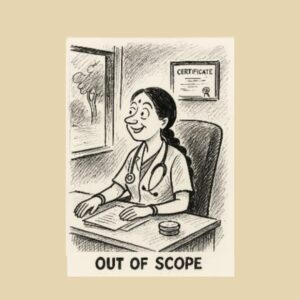
The man who enters my consultation room sizes me up before I can size him up. From whatever assumption he makes of my (lack of) personality, he pulls out a chair, props himself down, lays out his three smartphones on my consultation table, and grabs a pen from the penholder to pick at the food lodged between his teeth. A pale girl, no more than nine years of age, trails behind him, very much like a trickle of sweat.
Torn between directing him to our friendly neighborhood dentist, and letting him know I am no ‘sister’ but the doctor him…er…herself, I watch him drum my consulting table with all ten jewel-ringed fingers.
“What seems to be the problem?” I ask, looking at the girl.
“My niece needs spectacles.”
This isn’t the first time a patient has told me the diagnosis, when all I ask for is their complaint. From ‘viral’ to cancer, sore eyes due to garbage thrown by their neighbour on their porch to ‘acute exacerbation of chronic dacryocystitis,’ diagnoses are hurled at me while I wriggle through a maze of leading questions and overconfident, dodgy answers.
Sometimes they state the medication and ask me to write the prescription. “That’s all.”
They even glance at the male optometrist and ask if he, the ‘big doctor,’ will be seeing them.
I wonder what role I play in these situations. Certainly not their doctor. A stenographer, maybe. Or a doormat.
And that gets me thinking about all the roles we, the eye-doctors, play, day in and day out.
The reed-thin man gawks at me while ushering in a woman with a kerchief over one blackened eye.
As I begin examining her, he hovers around my table.
“She can see fine. Just make it white again.”
My nurse gives me a knowing nod.
The black eye chronicles. Timid wife. Drunk husband. Poverty, or prosperity. The hovering husband is always a sign.
“Let me examine her first,” I say, stiffly. “How did you get hurt?”
“We’re in a hurry,” he buzzes.
“Sure. Hence the delay. A blood clot is staining the cornea. It must be days old.”
“Doctor, just make it white.”
I grip my pen tighter, making my knuckles very, very white.
“She needs rest. Medication. Follow-ups.”
As I scrawl on the prescription pad, “We also need to examine…”
“How long until it turns white?”
While I turn white, red and purple, the nurse waves cheerfully, as if swatting away the man’s impatience. “It will take time. We first must check for deeper injuries.”
God bless the ‘sister’ who saves the day when my mood goes sinister. As the couple exits, the woman whispers, “I know what it looks like, madam. But I fell when the bike jumped a pothole. My husband is a good man.”
I smile knowingly. This once, I am playing the role of the audience. Watching. Applauding. Ignoring the bruises on her wrist.
 A four year old boy tries to read the distance vision chart, but his mother won’t let him finish.
“Oh, he knows it! That’s not a ‘Y’. Beta, T for?”
“T for ‘T’-oo much pressure,” I mutter.
“What?”
“Nothing. But he needs to reduce screen-time.”
“See? The doctor is asking you to stop watching on the phone..”
Standard reaction.
Then comes: “We tell him. He doesn’t listen.”
That’s my cue to launch into a root-cause-analysis lecture. “Madam, it is we who have introduced kids to smartphones. We must now wean them.”
There is also the vigilant-parent variant: “We never allow gadgets near our child. He has never so much as glanced at the TV in his life. Why spectacles for our kid then?”
“There are many reasons. One is heredity,” I say, looking at the bespectacled father.
“I see,” he says. He shoots the mother a look. She shoots him two.
“But if he stops watching so much TV, he won’t need glasses, no?”
I sigh. And proceed to play the role of a parent counsellor.
Sometimes we’re therapists at Alcoholics Anonymous meetings.
“Any addictions?” I ask.
“Never,” says the fifty-year-old with tremors and jaundiced eyes. He has bags under his eyes deep enough to hold a bottle of whiskey. Each.
His wife nods vehemently behind him, gesticulating wildly. Doctor, tell him to stop.
“Your optic nerves show signs of alcohol toxicity. You must stop,” I say, smiling at her, making a mental note to curb my patient-pleasing tendencies.
Only once in all these years, I remember a wife dragging her husband back to my clinic, demanding I say it’s okay to drink. Officially. Apparently, he was unbearable when sober.
And the beautician.
“You need to stop using so much eye makeup, especially if it is past its expiry date. It’s worsened your infection.”
“Oh, but I use it only occasionally.”
I skip pointing out the kohl pigment inclusion bodies in her conjunctiva.
“What brand of makeup would you recommend, doctor?”
“The one so expensive you wouldn’t share. Or buy.”
I believe she will change her brand. Of an eye doctor.
Dieticians? Yes.
A typical post-operative first day visit goes thus:
Daughter-in-law: “Can he eat rice?”
Wife: “Brinjal?”
Elder son: “Medication?”
Younger son (obliged to ask, under pressure): “Non-veg?”
Patient: “Gulab Jamun?”
A distant relative over the phone, on speaker mode: “Avocado?”
I generally tell them all of it is fine, as far as they don’t directly apply it to the eye.
The role we play most however: The philanthropist.
We are expected to give away our Sundays, our kids’ school annual function, therapy appointments, and sanity- for free. Because we have mutual friends on Facebook. Or we are neighbors. Or because once our dogs barked at the same time.
For their surgery they want the best implants, the smallest incision, robot-assisted surgery—
“But don’t worry. We’ll pay for the robot. Your fees? Isn’t it a labour of love?”
You now have an idea.
We’re also:
Zumba trainer: “What exercises for strong eyes?”
Begin with self-control. Delay binge-watching. Like my unpaid Sunday teleconsultation fees.
Google validator: “Do I have Lost Eyelid Syndrome?”
No, you would have noticed it. Also, I charge to explain why you don’t have cancer.
Career counsellor: “Laser off my son’s number. Army dream.”
“Yes, but his retina is weak.”
“Still qualifies, right?”
Gabbar Singh: “Eat greens or the doctor gives an injection.”
Once, a harried mother of a 25-year-old used it. He glared at me with his bloodshot eyes and dilated pupils. I only stared at the young man’s tattooed arms, full of puncture wounds.
Ear doctor:
Me: “No, I can’t prescribe for ears.”
Patient: “But here on the label it says eye/ear drops.”
Me: “My degree doesn’t.”
2-minute Maggi:
Them: “Make her beautiful. Wedding next month.”
Me: “She’s already beautiful.”
Them: “We meant her squint.”
Me: “It’s from an old major eye ailment. Not fixable. The squint will recur. Plus, risk involved.”
Them: “Doesn’t matter. The wedding will be wrapped up by then.”
They look away when I refuse. The curtain falls on me.
Time to find another Maggi-maker.
Devil’s advocate:
Relative: “Tell her to watch less TV.”
Septuagenarian: “What else can I do all day?”
Me: “TV’s fine at your age.”
Marriage counsellor:
From roving eyes to stink-eyes, couples squabble while I try to convince them it is only a dry eye syndrome.
Once, my former 2 min Maggi squint patient came to see me, with her husband of one year.
She has a ‘new’ squint. No past history. She shows no sign of knowing me.
As per protocol, I order tests for a recent onset squint-probably a neurological cause. But I know better.
I scribble on the case paper: “Look into old records.”
***
It occurs to me; the one role I have failed miserably at is that of a Zen master. The day I manage to ace it; I might not have to play any of the others.
My favourite role till date, is one we play in silent observation. The role of a student. I watch in admiration as an aged couple walks hand in hand, his stiff frozen shoulder steadied by her hand, her limp from arthritis balanced by him leaning in. The terminally ill man who cracks the most ridiculous jokes to cheer his dejected wife. The daughter who shuttles between two cities every weekend, to make sure she is present for her parents’ follow up visits. The son holding his mother’s urinary bag, as we try to maneuver her wheelchair in front of the slit lamp, to examine her puffy eyes. I am taking notes in empathy, a few in courage.
I guess, the roles I play will keep evolving. We, as a species, probably won’t.
On a rainy day, in a lull in my OPD, I look out of the window. Traffic. Hawkers. Potholes. And the big car bearing the one in charge of road repairs, riding right up to the parking area of the hospital.
Here comes one more VIP patient. I must gear up to play my final role of the day- the mop. To wipe off the last speck of self-awareness from their inflated ego. And wait upon them to tell me what my problem is. So I can treat them better.
The curtain rises, one again.