



Reverend John Wilson (1804–1875) was a Scottish missionary, orientalist, and educator whose life and work left an indelible mark on 19th-century India. Sent to Bombay (now Mumbai) by the Scottish Missionary Society in 1829, Wilson’s contributions spanned religious, educational, and scholarly domains, influencing both Indian society and British colonial perspectives.
Early Life and Missionary Calling
Born in Lauder, Berwickshire, Scotland, Wilson was the eldest of seven children. He pursued theological studies at the University of Edinburgh, where he developed a deep interest in linguistics and theology. In 1828, he was ordained as a minister in the Church of Scotland and married Margaret Bayne the same year. The couple embarked on their missionary journey to India in 1829, arriving in Bombay.
Missionary Work and Educational Endeavors
Upon settling in Bombay, Wilson focused on spreading Christianity through preaching in multiple languages, including Marathi, Hindustani, and Gujarati. He established the Ambroli English School in 1832, which later evolved into Wilson College, a prominent educational institution in Mumbai. This school laid the foundation for higher education in the region.
Wilson’s commitment to education extended to women’s empowerment. His first wife, Margaret Bayne, established the first girls’ boarding school in western India in 1829, which eventually became St. Columba’s High School in Mumbai. Following her untimely death in 1835, Wilson continued her work, founding six schools for girls, significantly advancing female education in the region.
Scholarly Contributions and Recognition
A passionate linguist and scholar, Wilson mastered several languages, including Gujarati, Hindi, Hebrew, Greek, Latin, Urdu, Persian, Arabic, and Zend. His linguistic expertise enabled him to translate rock inscriptions in Gujarat, earning him a Fellowship of the Royal Society in 1845. He also served as President of the Cave Temple Commission, overseeing the examination and recording of India’s cave temples and monasteries.
Wilson’s scholarly works include “The Lands of the Bible” (1847), “The Parsi Religion Unfolded, Refuted, and Contrasted with Christianity” (1843), and “India Three Thousand Years Ago” (1858). These publications reflect his deep engagement with Indian culture and history, contributing to the academic discourse of his time.
Role in Indian Education and Administration
In 1857, Wilson played a pivotal role in the establishment of the University of Bombay (now Mumbai University), serving as its first Vice-Chancellor in 1869. His leadership in the university underscored his commitment to advancing education in India. Additionally, he was a key figure in the Bombay Branch of the Royal Asiatic Society, serving as its President from 1835 to 1842, further solidifying his scholarly influence.
Legacy and Impact
Reverend John Wilson’s legacy is multifaceted. Through his missionary work, he introduced Christianity to various communities in India. His educational initiatives laid the groundwork for modern schooling systems, particularly for women. As a scholar, he bridged cultural and linguistic divides, fostering a deeper understanding of Indian heritage. His influence extended beyond his lifetime, with institutions like Wilson College and the John Wilson Educational Society continuing his mission of education and cultural exchange.
Reverend John Wilson’s life exemplifies the intersection of faith, education, and scholarship. His contributions to India’s educational landscape and his scholarly endeavors have left an enduring legacy, reflecting a commitment to cultural understanding and societal development.
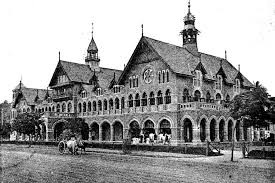
Wilson College, Mumbai … then
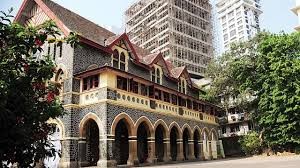
Wilson College, Mumbai … now
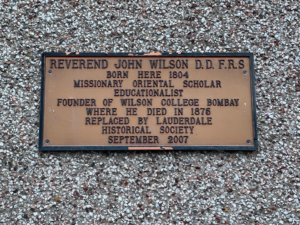
Plaque on his home in Scotland
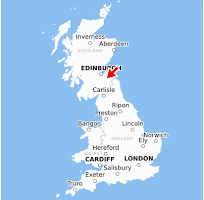
Lauder, Scotland

Reverend Wilson’s birthplace in Lauder, Scotland